

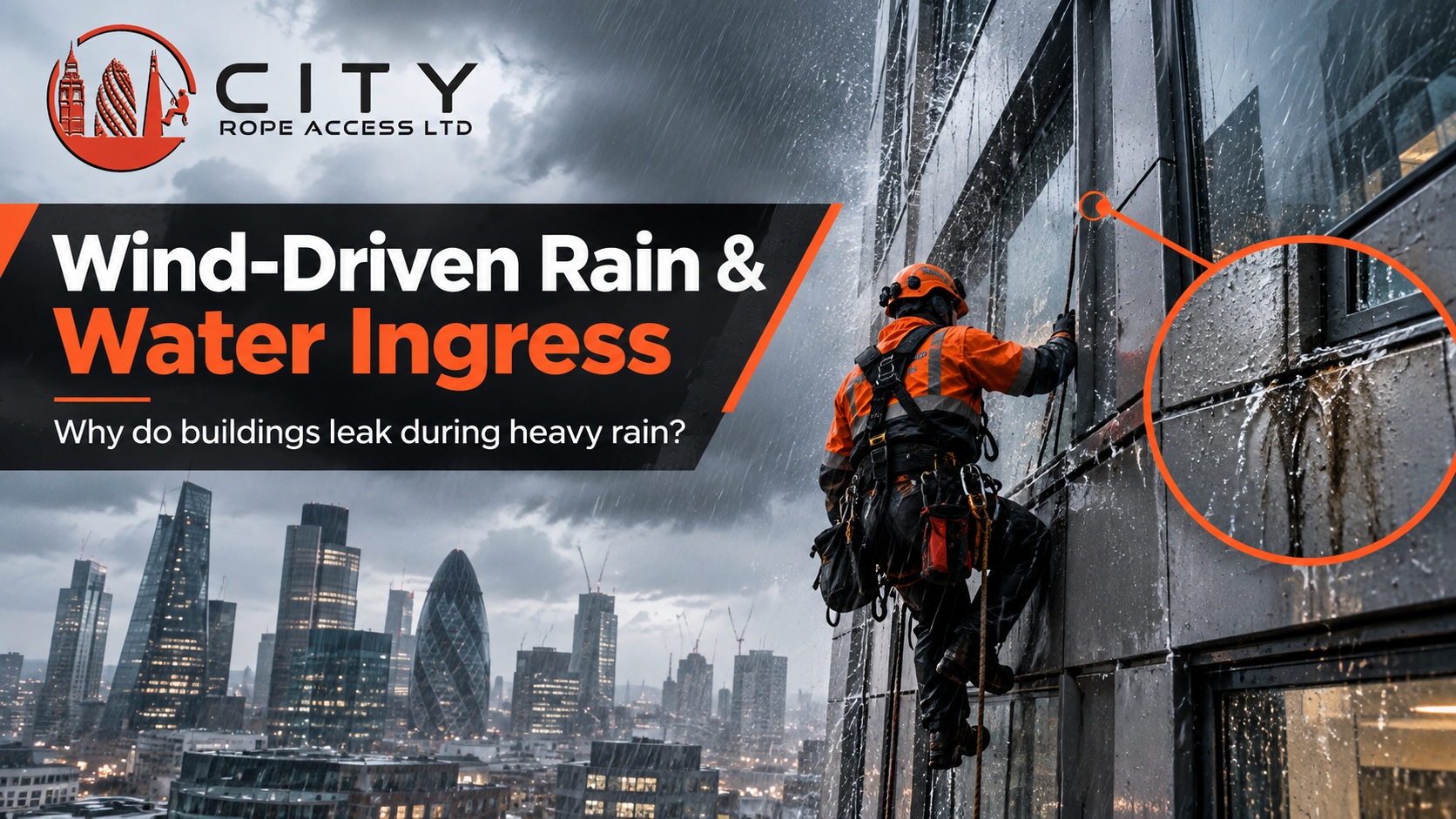
A building can remain completely dry during light rainfall and then suddenly develop leaks during a storm.
For property managers, landlords and building owners, this can be particularly frustrating. The roof may appear intact, windows may look correctly installed and there may be no obvious damage visible from ground level.
Yet whenever heavy rain combines with strong wind, water starts appearing around windows, ceilings or internal walls.
In many cases, the problem is not simply the amount of rain falling on the building.
The direction and force of the wind can push rainwater against the façade and into small defects that remain unaffected during normal weather conditions.
This is commonly known as wind-driven rain.
Understanding how wind-driven rain affects a building can make it much easier to identify the actual source of water ingress and avoid repeatedly repairing the wrong area.
What Is Wind-Driven Rain?
During calm weather, most rainfall falls relatively vertically.
Roofs, gutters, flashings and other drainage systems are designed to collect this water and direct it safely away from the building.
Strong wind changes the situation.
Rain can be driven horizontally against external walls, windows, cladding systems, balconies and other parts of the building envelope.
Instead of primarily affecting the roof, rainwater can begin attacking the entire elevation of the property.
For tall buildings, the problem can become particularly noticeable because upper floors are often exposed to stronger winds and more severe weather conditions.
If the façade contains even a relatively small defect, wind-driven water may find a route inside.
Potential entry points include:
- deteriorated window sealants,
- cracked masonry,
- defective pointing,
- cladding joints,
- damaged flashings,
- parapet walls,
- balcony waterproofing,
- movement joints,
- roof-to-wall junctions,
- drainage defects.
This is why a leak that appears only during a storm should not automatically be assumed to be a roof leak.
Why Does a Building Leak Only During Heavy Rain?
Water ingress often requires a particular combination of circumstances.
A small gap around a window frame may remain dry during ordinary rainfall because very little water reaches it.
During strong wind and heavy rain, however, water can be continuously forced against the same area.
The pressure and volume of water can expose weaknesses that are almost impossible to notice during normal weather.
Several building defects commonly cause this type of intermittent leakage.
Failed Window Sealants
External window sealants form an important weather-resistant joint between the window system and surrounding façade.
Over time, sealants can become:
- brittle,
- cracked,
- detached,
- separated from the frame,
- damaged by movement,
- affected by UV exposure and weathering.
A very small gap may be enough to allow water into the building during severe weather.
Once water passes behind the external seal, it may travel around the window frame or through the surrounding construction before appearing internally.
If leaks or damp patches regularly appear around windows after storms, deteriorated perimeter sealing should be one of the areas investigated.
Our guide to window sealant failure, warning signs and repair solutions explains the most common problems affecting external window joints.
Cracked Brickwork and Deteriorated Mortar
Brick and masonry façades are designed to withstand exposure to normal weather conditions, but they still require maintenance.
Cracking, missing mortar and damaged pointing can create routes through which water enters the external wall.
Problems may develop around:
- mortar joints,
- movement cracks,
- window openings,
- damaged bricks,
- previous repairs,
- interfaces between different materials.
During prolonged or wind-driven rainfall, masonry can also remain wet for longer periods.
Where cracks or defective joints are present, this increases the opportunity for water to penetrate deeper into the wall construction.
Our article on masonry repairs and common masonry defects explains how these problems develop and when repairs may be necessary.
Damaged Parapet Walls and Coping Stones
Parapet walls are among the most exposed parts of many commercial and residential buildings.
They sit above the main façade and can experience significant exposure to:
- rain,
- wind,
- temperature changes,
- frost,
- standing water.
Defective coping stones, cracked joints, failed membranes or deteriorated masonry can allow rainwater into the top of the wall.
From there, moisture may travel downward through the construction.
The resulting damp may appear considerably lower than the original entry point.
This can make parapet defects surprisingly difficult to diagnose without a close-up inspection.
Read our guide to parapet wall damage, warning signs and repair options for more information.
Defective Roof Flashings and Roof-to-Wall Junctions
Not every roof leak begins in the main roof covering.
Many problems occur around details and junctions.
Common examples include:
- damaged flashings,
- failed upstands,
- roof penetrations,
- membrane joints,
- parapet interfaces,
- roof edges.
During normal rain these areas may appear watertight.
During severe weather, however, wind can force water underneath loose or deteriorated details.
This is one reason building owners should consider both the roof and façade when investigating unexplained water ingress.
Our commercial roof inspection guide explains the common defects that should be checked during a professional roof survey.
Blocked Gutters and Rainwater Systems
A water ingress problem can sometimes have a much simpler cause.
When gutters, outlets or downpipes become blocked, rainwater cannot leave the roof efficiently.
During heavy rainfall, water may begin to:
- overflow from gutters,
- collect around roof edges,
- run down façades,
- penetrate joints,
- enter behind cladding,
- accumulate around flashings.
The volume of water involved during a storm can turn a minor drainage issue into a significant leak.
For more information, see our guide to blocked gutters on commercial buildings.
Balcony Waterproofing and Drainage Problems
Balconies introduce numerous joints, interfaces and drainage points into the building envelope.
Water ingress may originate from:
- defective waterproof membranes,
- failed joints,
- damaged coatings,
- blocked drainage outlets,
- cracks,
- poorly sealed penetrations,
- deterioration around balcony edges.
Standing water can increase exposure considerably during prolonged rainfall.
Water may then travel through the balcony construction before becoming visible on the floor below or inside an adjacent property.
If balconies form part of the affected elevation, our guide to balcony repairs and common high-rise balcony defects explains the warning signs worth investigating.
Cladding Joints and Panel Defects
Modern commercial buildings frequently rely on cladding systems to create the external building envelope.
These systems contain numerous joints, seals, fixings and interfaces.
Potential water entry points include:
- panel joints,
- failed seals,
- damaged panels,
- interfaces around windows,
- poorly sealed penetrations,
- movement joints,
- defective flashings.
A defect may be extremely difficult to identify from ground level.
A close-up cladding inspection can help identify deterioration and potential routes through which water is entering the façade.
Why the Visible Leak May Be Far Away From the Actual Defect
One of the most important things to understand about building leaks is that:
the place where water becomes visible is not necessarily the place where water entered the building.
Water follows the easiest available route.
After entering the external envelope, it may travel:
- behind cladding,
- along beams,
- through insulation,
- around window frames,
- along membranes,
- through cavities,
- across ceilings,
- down structural elements.
For example, water may enter around a failed façade joint several metres above a window and only become visible internally around the window opening.
Similarly, moisture entering behind a parapet may travel downward before producing a damp patch on a ceiling.
This is why simply sealing the area immediately outside the visible damp patch does not always solve the problem.
The entire potential water path must be considered.
Why Façade Water Ingress Can Be Difficult to Diagnose From Inside
Internal inspection is useful because it helps identify where moisture is becoming visible.
However, it rarely provides the complete picture.
The actual defect may be several floors above the affected area or positioned behind an external façade component that cannot be inspected from inside.
This becomes especially challenging on high-rise buildings.
From ground level, technicians may be able to identify obvious problems such as:
- major cracks,
- missing cladding panels,
- overflowing gutters,
- severe staining.
Smaller defects can easily remain hidden.
A gap of only a few millimetres around a window or façade joint can be extremely difficult to see from street level.
Close-up external inspection is therefore often necessary when the source of a recurring leak remains unclear.
How Professionals Investigate Façade Water Ingress
A successful water ingress investigation should focus on identifying the source rather than simply treating the visible symptoms.
The investigation will depend on the construction of the building, but may include several stages.
Review When the Leak Occurs
The circumstances surrounding the leak can provide important clues.
Useful information includes:
- whether the problem occurs during every rainfall,
- whether strong wind is required,
- which direction the wind is coming from,
- how long it takes for water to appear,
- whether the leak continues after the rain stops,
- which floors or elevations are affected.
A leak that repeatedly occurs only when wind comes from one direction can indicate a defect on a particular elevation.
Inspect the Building Envelope
External inspection may include checking:
- window perimeters,
- sealants,
- masonry,
- pointing,
- façade joints,
- cladding,
- parapets,
- flashings,
- balconies,
- movement joints,
- roof edges,
- drainage systems.
The objective is to identify potential entry points and understand how water could travel from them to the affected internal area.
Document Defects
Photographic documentation can be extremely valuable.
It allows property managers and maintenance teams to see areas of the building that may otherwise be inaccessible.
Photographs also make it easier to:
- prioritise repairs,
- compare deterioration over time,
- prepare quotations,
- plan maintenance programmes,
- verify completed repairs.
Carry Out Targeted Testing Where Appropriate
Where visual inspection does not identify an obvious cause, targeted testing may be required.
The exact method depends on the building and suspected defect.
Testing should be controlled carefully so individual areas can be assessed without introducing unnecessary water into the building.
How Rope Access Helps Locate Difficult Façade Leaks
Access is often one of the biggest challenges when investigating water ingress on tall buildings.
A defect may be located:
- several storeys above ground,
- above a courtyard,
- beneath a roof edge,
- around high-level glazing,
- behind a parapet,
- on an elevation inaccessible to conventional equipment.
Rope access allows trained technicians to inspect these areas at close range without surrounding the entire building with scaffolding.
Technicians can move directly to the suspected area and inspect individual façade components in detail.
This may include checking:
- cracked sealants,
- mortar joints,
- flashings,
- cladding interfaces,
- window frames,
- drainage systems,
- waterproofing details.
Where suitable, minor remedial work may also be completed using the same access system.
City Rope Access provides specialist rope access leak detection and waterproofing services in London for commercial, residential and high-rise properties where conventional access may be difficult or disruptive.
What Should You Do If Your Building Leaks Only During Storms?
Do not wait for the next storm before investigating the problem.
Intermittent leaks can sometimes continue for months because the building appears completely dry between periods of severe weather.
During that time, hidden moisture may continue affecting the building envelope.
If possible, record the circumstances every time the leak occurs.
Note:
- The date and time.
- Approximate intensity of rainfall.
- Wind direction.
- Which room or area was affected.
- Where the water first became visible.
- Whether the leak stopped when the weather improved.
- Any photographs or videos of the problem.
This information can help identify patterns.
It is also worth checking whether several occupants on the same building elevation experience similar problems.
Multiple leaks occurring during the same weather conditions can indicate a wider façade or drainage issue rather than an isolated internal defect.
Warning Signs of External Water Ingress
Not every water ingress problem produces an obvious active leak.
Some develop slowly.
Warning signs may include:
- damp patches,
- peeling paint,
- bubbling plaster,
- staining around windows,
- mould,
- discoloured ceilings,
- damaged internal finishes,
- musty smells,
- white salt deposits,
- repeated damp after storms,
- staining on the external façade.
External warning signs may include:
- cracked sealants,
- open joints,
- damaged pointing,
- staining beneath façade joints,
- damaged render,
- overflowing gutters,
- loose flashings,
- cracked coping stones.
These signs should not automatically be treated as confirmation of the leak source, but they can help narrow down the investigation.
Why Repeated Temporary Repairs Often Fail
Water ingress investigations can become expensive when repairs are based on assumptions.
A contractor may seal the most obvious crack.
The leak returns.
Another area is sealed.
The leak returns again.
Eventually, multiple repairs have been completed without identifying the original defect.
A more effective approach is to investigate the building envelope systematically.
This means considering:
- where water could enter,
- how it could travel,
- what weather conditions trigger the problem,
- whether surrounding building elements show deterioration.
Repairing the underlying defect is more important than simply covering the location where water becomes visible.
Preventing Future Water Ingress
Preventative maintenance can significantly reduce the risk of unexpected leaks.
Building owners and property managers should regularly inspect areas including:
- roofs,
- gutters,
- rainwater outlets,
- external sealants,
- window perimeters,
- masonry,
- parapets,
- balconies,
- cladding systems,
- flashings.
Small defects are generally easier to address before water begins entering the building.
Regular inspections are particularly important after severe storms and for elevations exposed to prevailing winds.
City Rope Access also provides professional building repairs and maintenance services for difficult-to-access commercial and residential properties.
Water Ingress Problems Should Be Investigated Early
A building that leaks only during severe weather can be easy to ignore.
Once the rain stops, the problem disappears.
Unfortunately, the underlying defect remains.
Repeated water penetration can gradually affect insulation, internal finishes, masonry, sealants, concrete and other components.
Identifying the source early makes it possible to carry out targeted repairs before deterioration becomes more extensive.
If you manage a commercial, residential or high-rise property and are experiencing unexplained leaks during heavy rain, City Rope Access can inspect difficult-to-reach external areas and help identify potential sources of water ingress.
Find out more about our leak detection and waterproofing services or contact City Rope Access to discuss the problem.
Frequently Asked Questions
Why does my building only leak when it is windy?
Strong wind can drive rain directly against façades, windows and building joints. Small defects that remain dry during normal rainfall may allow water to penetrate when rain repeatedly hits the building under wind pressure.
Can rain penetrate through brickwork?
Water may penetrate masonry where bricks, mortar joints or pointing are cracked or deteriorated. Extended exposure to wind-driven rain can make these defects more noticeable.
Can failed window sealant cause water ingress?
Yes. Cracked, separated or deteriorated external sealants can create a route for rainwater around the window system. Find out more about window sealant failure and the warning signs to look for.
Why does a leak appear away from the actual entry point?
Water can travel through cavities, behind cladding, along structural components or around window systems before becoming visible internally. The visible damp patch may therefore be several metres away from the external defect.
Can blocked gutters cause water ingress?
Yes. Blocked gutters and outlets can cause water to overflow, collect around roof details or run down external façades. This may expose weaknesses in joints, masonry, flashings and waterproofing systems.
How do you find the source of a façade leak?
The investigation typically involves reviewing when the leak occurs, inspecting the external building envelope, identifying potential entry points and considering possible routes through which water could travel.
Can rope access be used to investigate leaks?
Yes. Rope access allows technicians to reach high-level windows, façades, roofs, parapets and other difficult locations for close-up inspection without requiring extensive scaffolding.
Do you need scaffolding to investigate a high-rise leak?
Not necessarily. Depending on the building and location of the suspected defect, professional rope access can provide direct access to high-level areas while reducing the need for large temporary access structures.
Should a building be inspected after severe weather?
If a building has experienced leaks, visible damage, overflowing drainage or other problems during severe weather, an inspection can help identify defects before they lead to further deterioration.
Who can inspect water ingress on a high-rise building in London?
For defects located on inaccessible façades, roofs or high-level building components, specialist rope access technicians can inspect the affected area directly. City Rope Access provides leak detection and waterproofing services in London for difficult-to-access properties.