

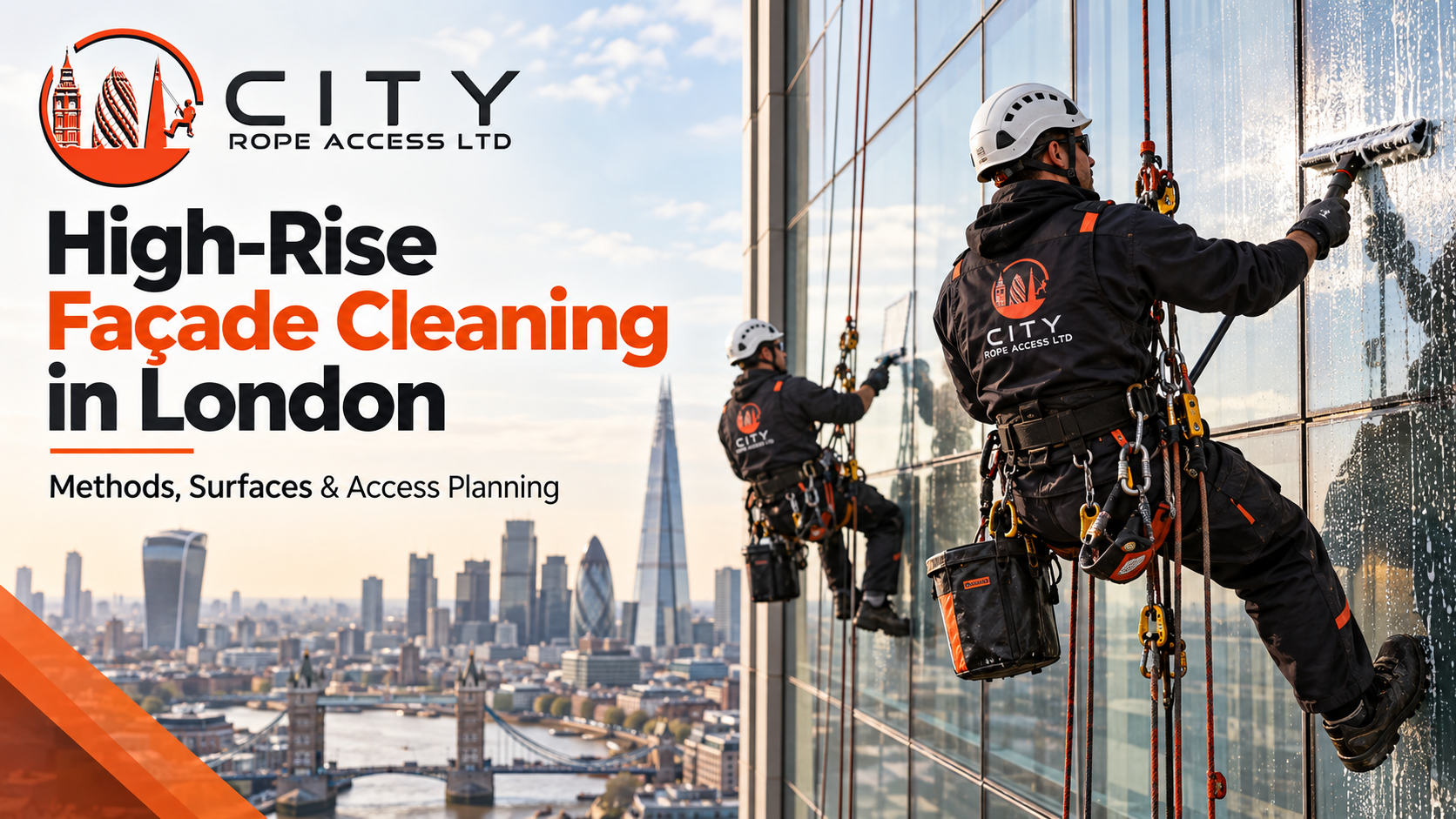
High-rise façades in London are exposed to traffic pollution, weathering, organic growth, staining and general surface contamination throughout the year. Over time, these deposits can affect the appearance of a building and may also make it more difficult to assess the condition of external surfaces.
High-rise façade cleaning in London therefore requires more than choosing a cleaning machine and starting work. The building material, type of contamination, height, surrounding environment and available access all influence how the project should be approached.
This guide explains the main factors property managers, facilities teams and building owners should consider when planning façade cleaning on tall or difficult-to-access buildings.
What Is High-Rise Façade Cleaning?
High-rise façade cleaning involves removing dirt, atmospheric deposits, staining and other contamination from the external surfaces of taller buildings. Depending on the structure, the work may involve rope access, mobile access equipment, scaffolding or another suitable access method.
Why Façades Become Dirty
External elevations are continuously exposed to the environment. In a large city such as London, several sources of contamination can affect building façades at the same time.
Common examples include:
- traffic and atmospheric pollution,
- dust and general airborne deposits,
- rainwater streaking,
- organic growth in damp or shaded areas,
- residue around joints and drainage points,
- bird fouling,
- construction-related dirt,
- localised staining beneath façade details.
The pattern of staining can sometimes also indicate another building issue. Repeated marks beneath parapets, joints or drainage components may justify closer investigation before cleaning begins.
The Façade Material Should Be Identified First
One of the most important steps is understanding what the elevation is made from. A method that is appropriate for one surface may be unsuitable for another.
High-rise buildings in London can include surfaces such as:
- glass,
- metal cladding,
- painted panels,
- render,
- concrete,
- brickwork,
- stone,
- composite panels,
- sealant joints and interfaces between different materials.
Before selecting a cleaning method, the surface condition and existing coatings should therefore be considered.
Where defects are visible, a closer building façade inspection may be appropriate before cleaning work proceeds.
Not Every Façade Should Be Pressure Washed
Pressure washing can be useful on suitable exterior surfaces, but it should not automatically be treated as the default method for every building.
The condition of the substrate, existing paint or coatings, joints, sealants and adjacent elements all need to be taken into account.
Excessive pressure on an unsuitable or deteriorated surface may disturb loose material or expose existing defects. For that reason, the cleaning method should be selected according to the surface rather than simply according to the level of visible dirt.
For information about our commercial exterior cleaning service, see exterior building cleaning by rope access .
Common Façade Cleaning Methods
The most appropriate cleaning technique depends on the building and the contamination being removed.
Low-Pressure Cleaning
Lower-pressure methods may be considered where a more controlled approach is required or where the surface condition limits the use of stronger water pressure.
Pressure Washing
Pressure washing may be suitable for certain durable exterior surfaces, depending on the substrate, condition and type of contamination.
Manual Cleaning
Localised areas, sensitive details or small façade elements may require more controlled manual cleaning rather than a broad mechanical method.
Cleaning Cladding on High-Rise Buildings
Cladding systems often include several different components within the same elevation, including panels, joints, fixings, trims and sealants.
This means the cleaning process should consider more than the visible face of the panel. Areas around joints and transitions should also be observed for obvious signs of deterioration.
Where there are concerns about panel condition, joints or fixings, a high-level cladding inspection can be carried out separately from the cleaning work.
Cleaning Rendered and Painted Façades
Rendered or previously painted elevations require particular attention to surface condition.
Before cleaning, visible issues may include:
- flaking or peeling coatings,
- surface cracking,
- localised staining,
- loose material,
- failed joints around windows and panels.
Cleaning a façade without first recognising these problems can make it harder to separate maintenance requirements from purely cosmetic work.
If repainting is being considered after cleaning, see our guide to high-rise exterior painting in London .
Concrete, Brick and Masonry Façades
Concrete and masonry elevations can develop staining as well as physical deterioration. Cleaning may improve visibility of the substrate, but it does not replace repair work where defects are present.
Issues such as cracking, spalling, deteriorated pointing or loose masonry should be assessed separately.
You can learn more in our guides to concrete spalling and common masonry defects and repairs .
Why Access Planning Matters on High-Rise Buildings
Cleaning the surface is only one part of the project. The second major consideration is how technicians can reach the required working area.
The access solution may depend on:
- building height and geometry,
- roof configuration,
- location of the affected elevation,
- ground-level restrictions,
- pedestrian and vehicle movement,
- the amount of façade being cleaned,
- the tools and equipment required.
When Rope Access Can Be Used for Façade Cleaning
Rope access can be appropriate where technicians need direct access to high-level or difficult-to-reach areas of an elevation.
It may be particularly useful for localised work or buildings where façade areas can be reached from suitable high-level access points.
The suitability of rope access should be assessed for the individual building and scope rather than assumed for every project.
Rope Access, MEWP or Scaffolding?
There is no single access method that is correct for every façade cleaning project.
| Access Method | Typical Considerations |
|---|---|
| Rope Access | Direct access to high-level and localised façade areas where suitable anchor and access arrangements are available. |
| MEWP | May suit elevations that can be reached from an appropriate ground-level working position. |
| Scaffolding | May be appropriate where prolonged access across larger areas is required. |
The choice should be based on the building, scope, duration and practical access requirements.
Cleaning Occupied Commercial Buildings
Many façade cleaning projects take place while offices, hotels, residential blocks or other commercial properties remain occupied.
Planning may therefore need to consider:
- building entrances,
- pedestrian routes,
- loading areas,
- opening hours,
- neighbouring properties,
- water management,
- potential disruption around working areas.
These practical details can influence both the access method and the sequence of work.
Should the Façade Be Inspected Before Cleaning?
Not every cleaning project requires a separate detailed inspection. However, if visible deterioration is already present, closer observation may help identify areas that need repair before or alongside cleaning.
Examples include:
- cracked render,
- loose masonry,
- failed external sealant,
- damaged coatings,
- water staining beneath joints,
- concrete deterioration.
For more information, see our guide to common façade defects .
Water Staining Can Indicate More Than Dirt
Dark staining or repeated marks on an elevation are sometimes treated as a simple cleaning problem. In some cases, however, the pattern may be associated with water movement across the façade.
Possible sources can include deteriorated joints, parapet details, external seals or drainage components.
Where water ingress is suspected, cleaning alone will not address the underlying source.
Our article on wind-driven rain and façade water ingress explains some of the common mechanisms in more detail.
Check Sealant Around Windows and Façade Joints
Sealant is commonly found around windows, panels and other façade interfaces. During high-level cleaning, these areas may be visible at close range.
Cracking, separation or deterioration should not automatically be treated as part of the cleaning scope, but the condition may justify separate remedial work.
Read more about window sealant failure or visit our rope access mastic and sealant service .
What Affects the Cost of High-Rise Façade Cleaning?
The cost of a façade cleaning project depends on much more than the height of the building.
Typical factors include:
- size of the working area,
- building height and geometry,
- surface material,
- type and severity of contamination,
- required cleaning method,
- access arrangement,
- site restrictions,
- whether cleaning is localised or covers multiple elevations.
For this reason, a quotation normally needs to be based on the actual building and required scope rather than a standard price per project.
Four Steps Before High-Rise Façade Cleaning
1. Identify the façade material
Establish the substrate, coatings and external elements that will form part of the work.
2. Assess the condition
Note any obvious deterioration, damaged joints or areas that may require closer investigation.
3. Select the cleaning method
Match the cleaning technique to the surface and type of contamination.
4. Plan access and site logistics
Consider how the working area can be reached and how the work interacts with the occupied building and surrounding site.
What Information Should a Property Manager Provide?
Providing basic project information can make an initial assessment more useful.
Where available, this can include:
- building address,
- photographs of the elevations,
- approximate area requiring cleaning,
- known façade materials,
- information about roof or high-level access,
- details of any known defects,
- site restrictions or working-hour requirements.
Can Cleaning Be Combined With Other Façade Maintenance?
Yes, where appropriate, façade cleaning may form part of a wider building maintenance programme.
If technicians are already accessing an elevation, other separately scoped work might include visual inspection, localised sealant replacement, painting or minor remedial work.
The actual combination of services will depend on the condition of the building and the agreed project scope.
For wider maintenance information, visit our rope access building maintenance page.
Frequently Asked Questions About High-Rise Façade Cleaning
How are high-rise façades cleaned?
The method depends on the façade material, contamination and building access. Projects may use controlled water cleaning, pressure washing on suitable surfaces, manual cleaning or other methods appropriate to the substrate.
Can rope access be used for façade cleaning?
Rope access can be used where technicians can safely access the required high-level areas using a suitable rope access system. The building and scope should be assessed before selecting the access method.
Can every façade be pressure washed?
No. Pressure washing is not appropriate for every surface. The substrate, existing coatings, joints and overall condition should be considered before selecting the cleaning method.
Can façade cleaning identify building defects?
Cleaning can improve visibility of external surfaces, and technicians working close to the elevation may notice visible deterioration. A cleaning project, however, should not automatically be treated as a formal building inspection unless inspection is specifically included in the scope.
How often should a high-rise façade be cleaned?
There is no single interval suitable for every property. The required frequency depends on the building location, façade material, exposure, type of contamination and the appearance or maintenance requirements of the property.
Planning High-Rise Façade Cleaning in London
A successful façade cleaning project starts with understanding the building rather than simply choosing a cleaning method.
Surface type, existing condition, contamination, access and site restrictions should all be considered before the scope is finalised.
For commercial and high-rise buildings where external areas are difficult to reach, rope access may provide a practical way to reach specific elevations for cleaning and associated maintenance work.
Need to Discuss an Exterior Building Cleaning Project?
City Rope Access works on difficult-to-access commercial and high-rise building exteriors across London. Send us details of the property and required scope to discuss suitable access and cleaning options.
Contact City Rope Access