

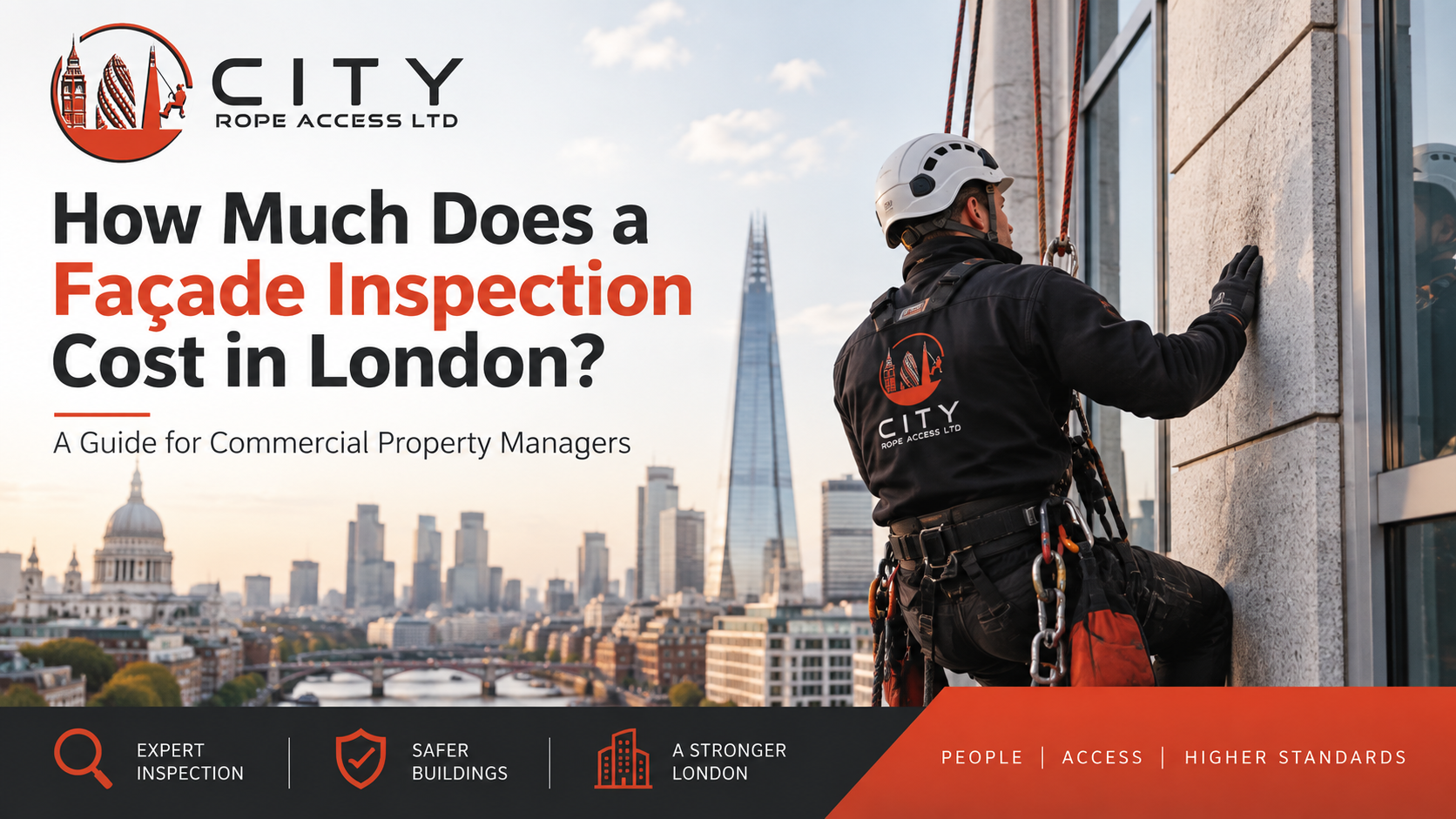
How Much Does a Façade Inspection Cost in London?
If you manage a commercial property in London, arranging a façade inspection is often far less expensive than dealing with the consequences of a defect that has been ignored for too long.
Cracked masonry, deteriorated sealants, loose cladding, concrete damage and water ingress can all begin as relatively minor problems. When they develop several storeys above ground level, however, identifying and repairing them becomes considerably more complicated.
One of the first questions property managers naturally ask is:
How much does a façade inspection cost?
Unfortunately, there is no single price that applies to every building.
The cost of a façade inspection in London depends on the height and size of the property, the number of elevations that need to be inspected, the condition of the façade, the access method required and the level of reporting expected.
A small targeted investigation of one suspected defect will be very different from a complete close-up inspection of a multi-storey commercial building.
Understanding what influences the price makes it much easier to plan an inspection and avoid paying for an access system that the project does not actually require.
What Determines the Cost of a Façade Inspection?
Several factors influence the final cost of inspecting a commercial building façade.
The most important consideration is usually not the inspection itself, but how technicians can safely reach the areas that need to be examined.
Building Height
The higher the property, the more specialist the access requirements may become.
Ground-floor masonry can often be inspected easily, while defects located around roof level, parapets, upper-storey windows or high-rise cladding require an appropriate working-at-height system.
Height does not automatically mean that scaffolding is required.
For many commercial buildings, rope access allows technicians to reach individual elevations directly without surrounding the entire property with a temporary access structure.
Size of the Building
A six-storey building with one relatively simple front elevation will normally require less inspection time than a large commercial development with multiple façades, courtyards, balconies and different construction materials.
The inspection area may include brickwork, stone, render, concrete, cladding, glazing, balconies, parapets, sealants, movement joints and other external elements.
The larger and more complex the building envelope, the longer a detailed inspection is likely to take.
Number of Elevations
Sometimes only one section of a property needs investigation.
For example, a facilities manager may have discovered water staining around windows on the rear elevation or loose material below one section of masonry.
In other cases, a complete building condition assessment may be required.
Inspecting four elevations will naturally involve more work than investigating one known problem area.
This is why providing photographs and a clear description of the issue before requesting a quotation can be extremely useful.
The Scope of the Inspection Matters
Not every façade inspection has the same objective.
A basic visual assessment may simply identify obvious deterioration.
A detailed close-up inspection can involve examining joints, masonry, fixings and surface conditions from a short distance while recording defects photographically.
Where a more comprehensive assessment of the property is required, City Rope Access also provides building surveying services in London.
The scope should therefore be agreed before work begins.
A professional inspection may be required to identify:
- cracks and movement in masonry;
- loose bricks, stone or render;
- damaged or deteriorated mortar;
- failed window sealants;
- water ingress routes;
- damaged cladding;
- corrosion around fixings;
- concrete deterioration;
- defective expansion joints;
- problems around parapets, balconies and roof edges;
- areas requiring immediate repair;
- defects that should be monitored over time.
A more detailed inspection and report will require more time than a quick investigation of a single known defect, but it can also provide much better information for planning future maintenance budgets.
Visual Inspection vs Close-Up Façade Inspection
One of the biggest differences in façade inspection cost comes from the level of access required.
A building may appear to be in reasonable condition when viewed from street level.
That does not necessarily mean that the façade is defect-free.
Small cracks, loose mortar, deteriorated sealants and problems with fixings can be extremely difficult to identify from the ground, particularly on taller properties.
For this reason, a close-up inspection can provide significantly more useful information.
Technicians are able to examine individual areas directly and photograph defects that may otherwise remain unnoticed.
If you are looking for a practical overview of the areas that should be checked during an inspection, see our Building Façade Inspection Checklist.
That guide focuses on what should be inspected, while this article focuses specifically on the factors that determine the cost of arranging the inspection.
How Access Method Affects Façade Inspection Cost
Access can represent a significant proportion of the overall project cost.
The appropriate method depends on the building, location, inspection scope and duration of the work.
Common options include scaffolding, mobile elevating work platforms and industrial rope access.
Scaffolding
Scaffolding provides continuous access to large sections of a building and remains extremely useful for major refurbishment and long-term construction projects.
However, for a relatively short inspection, the cost and time required to install and dismantle scaffolding can be disproportionate to the work itself.
There may also be additional considerations involving pavement space, access restrictions and disruption around an occupied property.
Mobile Access Platforms
A MEWP or cherry picker can provide convenient access where there is sufficient space around the building.
However, access may become difficult where elevations are positioned above courtyards, narrow passages, extensions or areas that cannot accommodate the equipment.
London properties frequently have precisely these types of access restrictions.
Rope Access
Rope access can be particularly effective when technicians need to inspect multiple high-level areas without installing a large temporary structure.
Once suitable anchor arrangements and safety procedures are established, technicians can move directly across difficult-to-access sections of the façade.
For inspections, minor repairs and targeted maintenance, this can significantly reduce mobilisation requirements and disruption around the property.
For a more detailed comparison of the two methods, read Rope Access vs Scaffolding Price London – Which Is Cheaper?.
Is Rope Access Cheaper for a Façade Inspection?
In many situations, it can be.
The main advantage is that you are not necessarily paying for a large access structure before the inspection itself can even begin.
Rope access is particularly suitable where the objective is to inspect difficult-to-reach parts of an existing building rather than provide continuous access for a large construction team.
It can also allow a property manager to start with an inspection before deciding whether larger repair works are necessary.
This distinction is important.
Erecting extensive scaffolding before the condition of the façade is fully understood may result in unnecessary costs.
A targeted inspection can first establish:
what is damaged, where the damage is located, how urgent the problem is and what type of repair is likely to be required.
The appropriate repair access method can then be selected using much better information.
Why There Is No Reliable Flat Price for Every Façade Inspection
You may come across websites advertising a single façade inspection price.
For commercial properties, this can be misleading.
Consider two buildings.
The first is a relatively modern six-storey office building with straightforward roof access and one elevation requiring investigation.
The second is a high-rise residential development with balconies, recessed sections, multiple elevations, restricted roof access and concerns involving several different façade materials.
Both require a “façade inspection”, but the amount of time and access planning involved is completely different.
For that reason, a quotation should reflect the actual building rather than simply applying a generic price.
What Information Is Needed for an Accurate Quote?
The more information available before the site visit, the easier it is to estimate the likely scope of work.
When requesting a façade inspection quotation, it is useful to provide the property address, approximate number of storeys, photographs of the building, the elevations requiring inspection and a brief explanation of any known problem.
If water ingress, cracks, loose material or another specific defect has already been identified, include photographs whenever possible.
It is also helpful to explain what you expect after the inspection.
For example, do you require only identification of a suspected defect, photographic evidence, repair recommendations or a broader report covering multiple elevations?
Clear information allows the access and inspection requirements to be planned properly from the beginning.
What Should Be Included in a Professional Façade Inspection?
The exact scope should always be agreed before work starts.
However, a useful commercial façade inspection should do more than simply confirm that a building has “some cracks”.
Property managers need information that helps them make decisions.
A well-planned inspection should identify the location and nature of visible defects, record appropriate photographic evidence and distinguish between areas requiring urgent attention and those that can form part of planned maintenance.
The inspection may also identify problems that appear unrelated at first.
For example, staining beneath a window might be caused by failed sealant, defective masonry higher up the elevation or water travelling from another part of the façade.
Treating only the visible symptom may therefore fail to solve the underlying problem.
Common Problems Discovered During Façade Inspections
London buildings are exposed throughout the year to rainfall, pollution, wind, temperature changes and normal material ageing.
Over time, these conditions can expose weaknesses in the external envelope.
Common defects include cracked brickwork, deteriorated pointing, failed sealants, damaged render, loose masonry, corroded metalwork, concrete spalling, defective cladding joints and water staining.
Many of these problems develop gradually.
That is why early identification is so valuable.
If you have already noticed cracking, loose material, staining or another warning sign, our guide on how to spot façade defects before they become dangerous explains which symptoms should not be ignored.
Can a Façade Inspection Prevent Expensive Repairs?
An inspection cannot prevent materials from ageing, but it can prevent relatively small problems from remaining unnoticed until major repairs become necessary.
Imagine a deteriorated sealant joint allowing small amounts of water behind an external wall.
Initially, replacing the failed joint may be relatively straightforward.
If the problem continues for several years, moisture may begin affecting internal finishes, surrounding masonry, insulation or other components.
The repair then becomes larger and considerably more disruptive.
The same principle applies to loose mortar, concrete deterioration, damaged cladding fixings and many other external defects.
Regular inspections allow maintenance to become planned rather than reactive.
This is particularly important for commercial properties where emergency access arrangements can disrupt tenants, customers and normal business operations.
For a wider approach to property upkeep, see our Commercial Building Maintenance London guide.
How Long Does a Façade Inspection Take?
Inspection time depends on the size and complexity of the building.
A targeted investigation of one elevation may be completed relatively quickly.
A detailed assessment of multiple elevations will take longer, particularly where numerous defects need to be photographed and documented.
Weather conditions can also affect high-level access work.
Strong winds, heavy rain and other unsuitable conditions may influence when certain areas can be inspected safely.
For this reason, commercial inspection programmes should ideally be arranged before a problem becomes an emergency.
When Should You Arrange a Façade Inspection?
You should consider arranging a professional inspection whenever there is evidence that the condition of the external envelope may be changing.
Examples include new cracking, pieces of mortar or render found at ground level, repeated water staining, leaks around windows, loose cladding, rust marks, bulging surfaces or visible deterioration around parapets and balconies.
An inspection may also be worthwhile before planned refurbishment.
Understanding the actual condition of the façade can help determine which repairs should be prioritised and prevent budgets from being spent on purely cosmetic work while underlying defects remain unresolved.
Façade Inspections and Planned Preventative Maintenance
The most cost-effective inspection is often the one arranged before a major problem appears.
Planned preventative maintenance allows building managers to monitor gradual deterioration over time rather than repeatedly responding to emergencies.
Photographic records are particularly useful.
If the same areas are inspected periodically, photographs can show whether cracks are changing, corrosion is spreading or sealant deterioration is becoming more extensive.
This creates a much clearer maintenance history.
Our Preventative Building Maintenance Guide for Commercial Properties explains how regular external inspections can form part of a wider property maintenance strategy.
Should the Roof Be Checked at the Same Time?
In many cases, yes.
Roof and façade defects are often connected.
Water entering around roof edges, parapets, flashings or drainage systems may travel behind the building envelope before appearing internally many metres away.
Inspecting only the area where the damp becomes visible may therefore lead to the wrong conclusion.
Where there are signs of water ingress, it can be worthwhile checking both the façade and high-level roof details.
You can find more information in our Commercial Roof Inspection Guide.
What Happens After the Inspection?
The inspection itself should be the beginning of the maintenance decision-making process, not the end.
Once defects have been identified, they can be prioritised.
Some areas may require immediate action because loose material creates a potential safety risk.
Others may simply need monitoring or inclusion in the next planned maintenance programme.
Where repairs are required, rope access can often be used for both the inspection and subsequent localised work.
City Rope Access provides rope access building repairs and maintenance in London for difficult-to-reach commercial and residential properties.
Using the same access approach for inspection and repair can also simplify project planning where only individual areas of the building require attention.
How Much Does a Façade Inspection Cost in London?
The most accurate answer is that the cost should be based on the specific property.
Building height, façade size, access conditions, inspection scope and reporting requirements all influence the quotation.
For a straightforward targeted inspection, access may be relatively simple.
For a complex multi-elevation building requiring detailed photographic reporting, considerably more time may be necessary.
What matters most is choosing an inspection method appropriate to the building rather than automatically defaulting to the largest and most expensive access solution.
For many high-rise and difficult-to-access properties, rope access provides an efficient way to carry out close-up inspections while avoiding extensive temporary access structures.
Get a Façade Inspection Quote in London
If you manage a commercial or residential property in London and need to investigate cracks, loose masonry, water ingress, cladding defects or other high-level façade problems, City Rope Access can assess the access requirements and provide a quotation based on your building.
Providing photographs and details of the property can help the team understand the likely scope before work begins.
For a detailed assessment of the wider building, explore our building surveying services in London.
Alternatively, contact City Rope Access to discuss your property and the areas you need inspected.
Frequently Asked Questions About Façade Inspection Costs
How much does a façade inspection cost in London?
There is no single fixed price for every building. The cost depends on factors including building height, façade size, the number of elevations, access requirements, the inspection scope and the level of reporting required. Providing photographs and building information is usually the best way to obtain an accurate quotation.
Is rope access cheaper than scaffolding for façade inspections?
For many short-duration inspections and targeted high-level investigations, rope access can reduce access requirements because a full scaffolding structure does not need to be installed around the building. Scaffolding may still be appropriate for larger or longer-term projects requiring continuous access.
Can a high-rise façade be inspected without scaffolding?
Yes. Depending on the building and the areas requiring inspection, industrial rope access can allow trained technicians to reach high-level façades, balconies, roof edges, cladding and other difficult locations without full scaffolding.
What is included in a façade inspection?
The scope varies between projects but may include examination of masonry, render, concrete, cladding, window sealants, movement joints, balconies, parapets and other external components. Photographic documentation and recommendations can also form part of the inspection.
How long does a façade inspection take?
This depends on the property. A targeted investigation of a small area may be relatively quick, while a complete inspection of a large multi-storey building with several elevations will require considerably more time.
When should a façade be professionally inspected?
Professional inspection should be considered if you notice cracking, loose masonry, falling debris, damaged cladding, water staining, failed sealants, corrosion, concrete deterioration or persistent water ingress. Periodic inspections can also support preventative maintenance before visible problems become emergencies.
Can façade defects be repaired using rope access?
Many localised façade repairs can be completed using rope access, including sealant replacement, masonry repairs, minor concrete repairs, painting and certain maintenance works. The appropriate method depends on the extent and type of defect identified during the inspection.