

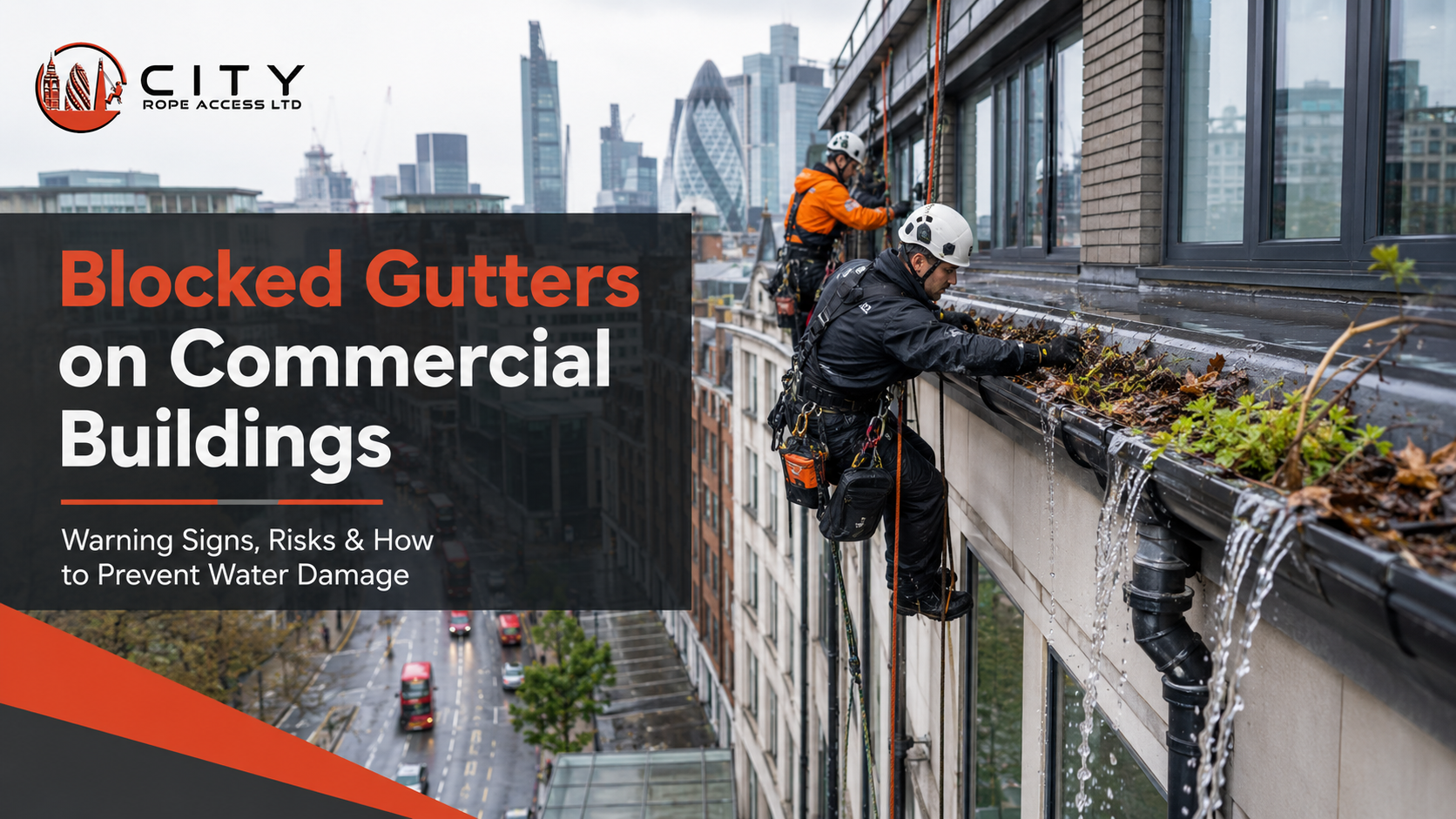
Blocked gutters on commercial buildings are easy to overlook because drainage problems often develop gradually and may remain hidden until heavy rainfall reveals them.
Leaves, moss, dirt, roofing debris and other material can restrict the movement of rainwater through gutters, outlets and downpipes. In other cases, the problem may be caused by a damaged joint, displaced gutter section or defective rainwater component rather than a blockage alone.
For property managers, the important point is to recognise the warning signs and investigate the drainage system before repeated overflow begins affecting other parts of the building.
This guide explains what can cause blocked commercial gutters, the signs to look for, how drainage problems can relate to water ingress and when high-level inspection may be useful.
Why Blocked Gutters Can Cause Problems on Commercial Buildings
A gutter system collects rainwater from the roof and directs it towards outlets, downpipes and the wider drainage system.
When water cannot move through the system correctly, it may begin to overflow, collect in unintended areas or run across external building surfaces.
Depending on the building, this can result in:
- Water overflowing gutter edges
- Standing water around roof-level drainage points
- Water running down façades
- Staining around outlets and downpipes
- Moisture reaching deteriorated joints or cracks
- Repeated wetting of masonry, render or other external finishes
A drainage defect does not automatically mean that water will enter the building, but it can increase exposure in areas where the building envelope already has weaknesses.
What Causes Commercial Gutters to Become Blocked?
There is rarely one single cause. Commercial rainwater systems are exposed to weather, surrounding vegetation and debris from the building itself.
Leaves and Organic Debris
Leaves can collect in gutters and around outlets, particularly on buildings close to trees.
When organic material becomes wet and compacted, it can restrict the flow of rainwater through the system.
Moss and Vegetation
Moss and other organic growth can become detached from roof surfaces and wash into gutters during rainfall.
Accumulation around outlets can reduce drainage capacity and in neglected areas vegetation may begin growing directly within the gutter.
Dirt and Atmospheric Deposits
Urban buildings are exposed to airborne dirt and pollution. Fine deposits can combine with organic material and gradually build up inside gutters and drainage channels.
Roof and Construction Debris
Fragments of roofing materials, sealants, mortar or other construction debris can enter the rainwater system during maintenance, refurbishment or natural deterioration.
Bird Activity
Nesting material, feathers and other debris associated with bird activity can sometimes restrict gutters and outlets.
Where bird activity is persistent, drainage maintenance and high-level bird proofing may need to be considered as separate parts of the wider maintenance strategy.
Damaged Gutters and Downpipes
Not every drainage problem is caused by debris.
Gutters and rainwater components may also be affected by:
- Cracked sections
- Failed joints
- Displacement or poor alignment
- Loose brackets or fixings
- Corrosion
- Damaged or disconnected downpipes
A clean gutter will not necessarily perform correctly if the drainage components themselves are defective.
7 Warning Signs of Blocked Gutters on Commercial Buildings
Drainage problems are often easiest to identify during or shortly after rainfall. The following signs may indicate that closer inspection is required.
1. Water Overflowing From the Gutter
Water flowing over the gutter edge rather than towards the outlet is one of the clearest signs that the rainwater system is not draining correctly.
The cause could be debris within the gutter, a restricted outlet, a blocked downpipe or another drainage defect.
2. Water Staining on the Façade
Dark streaks, staining or discolouration below gutters and roof edges can indicate repeated uncontrolled water movement.
Staining does not automatically reveal the cause, but it can help identify areas that warrant closer inspection.
3. Internal Damp After Heavy Rain
Internal damp can sometimes be associated with rainwater overflowing or collecting around defects in the external building envelope.
Possible entry points can include:
- Failed sealant joints
- Cracks in masonry or render
- Roof interfaces
- Window surrounds
- Parapets
- Other façade defects
The location of an internal damp patch does not necessarily identify the original point where water entered.
4. Standing Water Around Roof Drainage Areas
Restricted outlets can contribute to water remaining on flat or low-slope roof areas longer than expected.
Where standing water repeatedly appears around drainage points, the outlet and surrounding roof details may need to be reviewed.
5. Sagging or Displaced Gutters
Wet debris can add weight to gutter systems and existing damage to brackets or fixings may allow sections to move out of position.
Visible sagging, separation or misalignment should therefore be inspected rather than treated only as a cleaning issue.
6. Vegetation Growing From Gutters
Plant growth usually indicates that organic material has accumulated within the drainage system for some time.
Where vegetation is visible, there may also be debris restricting the movement of rainwater.
7. Water Escaping Around Downpipes
Water running from joints, behind pipework or around connections may indicate a blockage, failed joint or damaged rainwater component.
Closer inspection is usually required to determine whether the problem requires cleaning, localised repair or replacement.
Why Hidden Gutters Can Be Difficult to Monitor
Some commercial buildings use gutters or drainage channels that are not easily visible from ground level.
They may be positioned:
- Behind parapets
- Between roof levels
- Along recessed roof edges
- Above courtyards
- Behind architectural features
- On upper elevations
Because these areas cannot always be checked visually from below, a developing blockage may remain unnoticed until overflow or staining becomes visible elsewhere on the building.
This is one reason high-level drainage problems can be more difficult to diagnose than low-level gutter defects.
How Blocked Gutters Can Affect the Façade
When rainwater repeatedly overflows from the same area, nearby sections of the façade may remain wetter than intended.
Affected building elements can include:
- Brickwork
- Stonework
- Render
- Concrete
- Cladding
- Window surrounds
- Sealant joints
Where these materials already contain cracks, deteriorated mortar, failed sealants or other defects, repeated water exposure can make those problems more noticeable.
Visible staining should therefore be investigated before it is simply cleaned or painted over.
Can Blocked Gutters Contribute to Roof Leaks?
They can contribute to water-ingress problems where restricted drainage causes rainwater to collect around vulnerable roof details.
Areas worth checking can include:
- Drainage outlets
- Parapets
- Flashings
- Roof edges
- Membrane joints
- Roof penetrations
However, a blocked gutter should not automatically be assumed to be the source of every roof leak.
Where water ingress is occurring, the drainage system and surrounding roof details should be considered together.
See our commercial roof inspection guide for more information about common high-level roof defects.
Why High-Level Gutter Inspection Can Be Difficult
Commercial gutters, outlets and downpipes may be positioned several storeys above ground or in areas that cannot be reached easily using normal building access.
Examples include:
- Roof edges
- Areas behind parapets
- Narrow elevations
- Courtyards
- High-level downpipes
- Areas above occupied spaces
In these situations, the access method needs to reflect the building, location of the drainage components and required scope of inspection.
How Rope Access Can Help With High-Level Gutter Inspections
Where the building and work scope are suitable, rope access can provide close visual access to gutters, outlets, downpipes and surrounding roof-level areas.
A close-up inspection may identify:
- Accumulated debris
- Restricted outlets
- Cracked gutter sections
- Failed joints
- Loose brackets
- Damaged downpipes
- Localised corrosion
- Nearby staining or water-related defects
Photographs can also be used to document difficult-to-access areas and help property managers understand the visible condition of the system.
Where appropriate, localised cleaning or repair may be possible using the same access method.
Gutter Cleaning Is Only Part of the Inspection
Removing debris may restore water flow, but the surrounding drainage system should also be considered where problems have occurred.
Gutters
Check for visible cracking, corrosion, deformation, poor alignment and damaged joints.
Outlets
Check whether debris or other material is restricting the movement of water into the rainwater system.
Downpipes
Look for damaged sections, failed connections, visible leakage or signs of blockage.
Brackets and Fixings
Loose or deteriorated fixings may allow gutters or pipework to move away from their intended position.
Surrounding Roof Areas
Nearby debris may quickly re-enter a recently cleaned gutter or outlet.
Adjacent Building Fabric
Staining, deteriorated masonry, failed sealants and other visible defects may indicate where uncontrolled rainwater has been affecting the building.
How Often Should Commercial Gutters Be Inspected?
There is no single inspection or cleaning interval that is suitable for every commercial building.
The appropriate frequency depends on factors including:
- Building height and roof layout
- Gutter and outlet design
- Surrounding trees and vegetation
- Previous drainage problems
- Exposure to wind and rainfall
- Age and condition of the system
- Recent roofing or refurbishment work
Additional inspection may be appropriate where overflowing water, standing water, façade staining or other drainage problems have been observed.
The maintenance schedule should therefore reflect the condition and risk profile of the individual building rather than a fixed universal interval.
When Is a Useful Time to Check Commercial Gutters?
Rather than relying on one fixed seasonal schedule, property managers can use changes in weather and building condition to decide when additional checks may be appropriate.
Examples include:
- After significant leaf fall
- After severe weather
- Where heavy rain has exposed drainage problems
- Following roofing or façade work
- Where staining or overflow has recently appeared
- Where the building has a history of drainage problems
The objective is to identify developing issues before repeated overflow begins affecting other building elements.
Blocked Gutters and Water Ingress
Water ingress can be difficult to diagnose because the location where damp becomes visible internally may be some distance from the external defect.
Potential sources can include:
- Blocked drainage systems
- Roof defects
- Failed flashings
- Damaged masonry
- Failed sealants
- Window joints
- Parapet defects
For this reason, repairing only the area around an internal damp patch may not resolve the underlying problem.
Where the water source is unclear, see our rope access leak detection and waterproofing service .
What Should Property Managers Check After Heavy Rain?
Rainfall can provide useful information about how the drainage system is performing.
From a safe and accessible location, look for:
- Water overflowing gutter edges
- Unexpected water flowing from roof areas
- Staining around outlets
- Water escaping from downpipe joints
- Standing water on safely accessible roof areas
- New internal damp patches
- Water running repeatedly down external walls
Where unusual water movement is observed, the relevant drainage area should be investigated rather than assuming the issue has resolved once the rainfall stops.
When Should High-Level Drainage Be Professionally Inspected?
Professional high-level inspection may be appropriate where:
- The gutter or downpipe cannot be accessed safely
- Water repeatedly overflows during rainfall
- Façade staining has developed
- Internal damp appears after rain
- A downpipe appears blocked or damaged
- Standing water is repeatedly observed around roof drainage
- Gutters appear displaced or damaged
- Previous cleaning has not resolved the issue
- The source of water ingress remains unclear
The appropriate access method depends on the height, layout and condition of the individual building.
Rope Access Rainwater System Repairs in London
Where inspection identifies a defect in an external rainwater system, localised repair or maintenance may be required.
Work can involve selected high-level components such as:
- External downpipes
- Rainwater pipework
- Visible joints and connections
- Accessible outlets
- Localised damaged sections
- Brackets and fixings
For high-level rainwater repair work, see our rope access rainwater system repair service .
Where overflow has already contributed to wider façade deterioration, our rope access building maintenance services cover additional high-level repair work.
Concerned About Blocked or Overflowing Gutters?
Send us photographs of the affected area, details of when the problem occurs and the approximate location of the gutter, outlet or downpipe.
City Rope Access can review the high-level access requirements and determine whether rope access is suitable for inspection, cleaning or localised rainwater system work.
Frequently Asked Questions
Can blocked gutters cause damp inside a commercial building?
They can contribute to water-ingress problems where overflowing rainwater reaches cracks, failed joints, masonry, roof details or other weaknesses in the external building envelope.
How often should commercial gutters be cleaned?
There is no universal cleaning interval. Frequency should reflect the building, surroundings, drainage design, previous problems and condition of the system.
What are the common signs of a blocked gutter?
Warning signs can include overflowing water, façade staining, standing water around drainage areas, sagging gutter sections, vegetation growth, leaking joints and unexplained damp following rainfall.
Can blocked gutters affect brickwork?
Repeated overflow can increase moisture exposure on brickwork and deteriorated mortar joints. The effect depends on the condition of the masonry and duration of the problem.
Can blocked gutters contribute to roof leaks?
They can contribute where restricted drainage allows water to remain around vulnerable roof details, although other roof defects may also need to be investigated.
Can rope access be used for gutter inspection and cleaning?
Yes. Rope access can be useful for selected gutters, outlets and rainwater systems on high-level or difficult-to-access areas where the building and work scope are suitable.
Can a blocked downpipe cause a gutter to overflow?
Yes. A restriction further down the rainwater system can prevent water from leaving the gutter efficiently and may result in water backing up towards the outlet.
Should gutters be checked after severe weather?
Additional inspection may be appropriate after severe weather where debris, visible overflow, damage or other changes suggest that the drainage system may have been affected.
Why are hidden gutters difficult to maintain?
Hidden or recessed gutters may not be visible from ground level, so debris accumulation or drainage defects can remain unnoticed until overflow, staining or another symptom becomes visible elsewhere.
1 Comment