

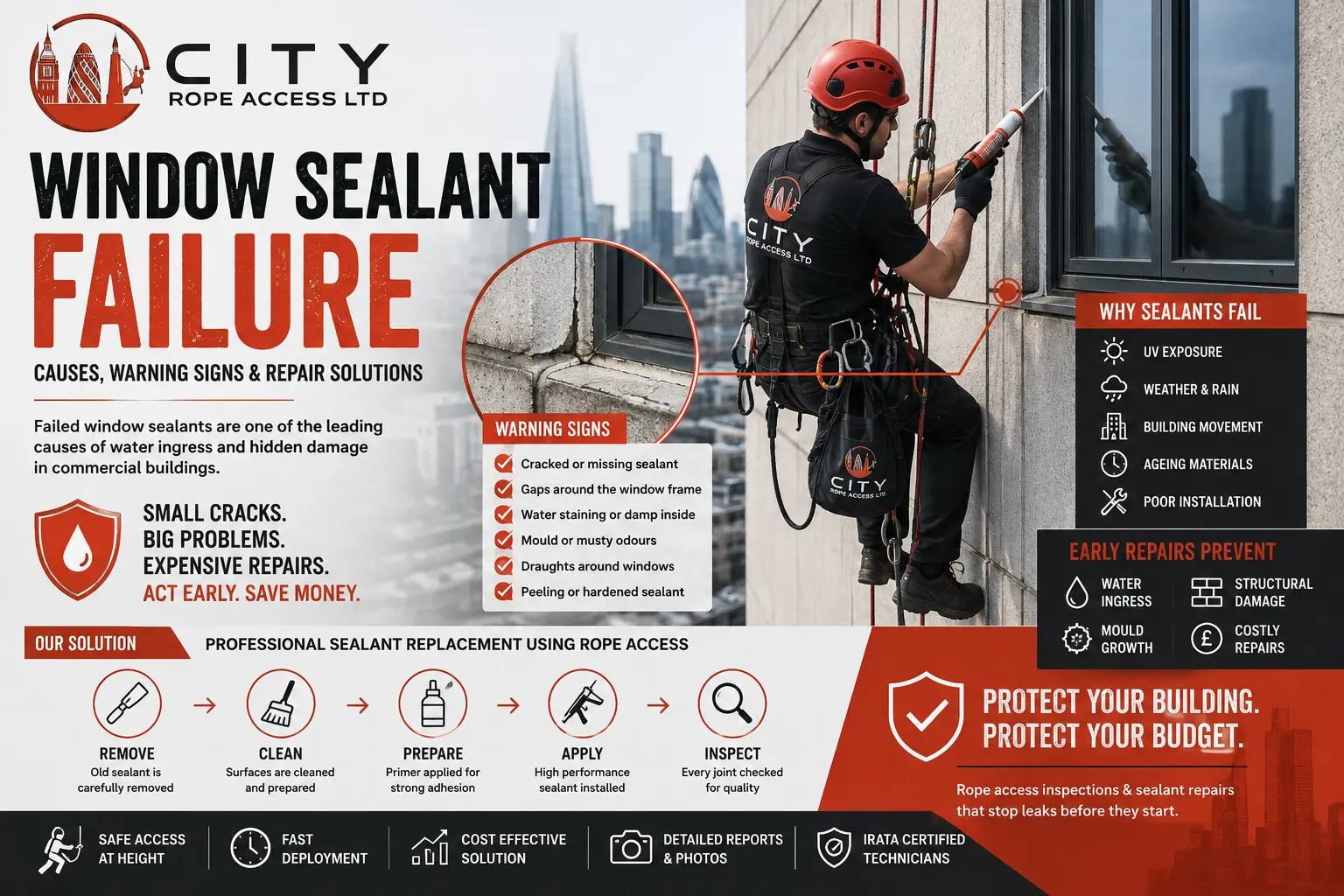
Window Sealant Failure – Causes, Warning Signs & Repair Solutions
A small gap around a window rarely attracts much attention.
There’s no broken glass. No obvious structural damage. In many cases, the only clue is a faint water stain on an internal wall or a slight draught near the frame.
Unfortunately, these subtle signs often point to a much bigger problem—window sealant failure.
Sealants are one of the building’s first lines of defence against water, wind and temperature changes. When they begin to deteriorate, moisture can enter the building envelope, causing hidden damage that may remain unnoticed for months.
For commercial buildings, replacing failed sealants is one of the simplest and most cost-effective maintenance tasks, yet it is also one of the most commonly overlooked.
What Is Window Sealant Failure?
Window sealants are flexible materials applied around window frames to create a watertight and airtight seal between the frame and the surrounding façade.
Over time, exposure to UV rays, rain, pollution and constant expansion and contraction causes these sealants to lose their flexibility.
Instead of forming a continuous barrier, they begin to crack, shrink or separate from the surrounding materials.
Once this happens, water and air can enter areas that should remain protected.
Why Do Window Sealants Fail?
Sealants are designed to withstand years of weather exposure, but they do not last forever.
Several factors contribute to deterioration.
Ageing Materials
Like all construction materials, sealants gradually lose elasticity as they age.
Older sealants become brittle, making them far more likely to crack during seasonal movement.
UV Exposure
Constant sunlight slowly breaks down the chemical structure of many sealants.
South-facing elevations often deteriorate faster than sheltered areas of the building.
Building Movement
Commercial buildings naturally expand and contract throughout the year.
Even small amounts of movement place continuous stress on window joints.
Eventually, the sealant may separate from the frame or surrounding masonry.
Poor Installation
Not every sealant failure is caused by age.
Incorrect preparation, poor adhesion or the use of unsuitable products can significantly reduce the lifespan of the joint.
Water Exposure
Standing water around window frames accelerates deterioration, particularly where drainage is poor or flashing details have failed.
Early Warning Signs of Sealant Failure
Many property owners only notice sealant problems after water has already entered the building.
Look out for:
- cracked sealant
- gaps around window frames
- peeling sealant
- hard or brittle joints
- water staining
- internal damp
- mould growth
- draughts around windows
- visible separation between the frame and façade
These warning signs should be investigated before more extensive repairs become necessary.
Our How to Spot Façade Defects Before They Become Dangerous
guide explains many of the external defects that often accompany failed window sealants.
What Happens If Sealants Are Not Replaced?
Ignoring failed sealants rarely saves money.
Over time, moisture entering through damaged joints can lead to:
- water ingress
- damaged plasterboard
- mould growth
- deteriorating insulation
- corrosion of steel components
- stained internal finishes
- concrete deterioration
- higher heating costs caused by air leakage
What starts as a small maintenance task can eventually become a major repair project.
Inspecting Window Sealants at Height
Many commercial buildings contain hundreds—or even thousands—of windows.
Inspecting upper floors from ground level simply isn’t possible.
Professional Rope Access Services
allow technicians to inspect every elevation closely without the need for extensive scaffolding.
Close-up inspections make it much easier to identify failed joints before leaks develop.
Replacing Window Sealants
Professional replacement involves much more than applying new silicone over the existing joint.
A proper repair normally includes:
Removing the Existing Sealant
Old material is completely removed to expose clean surfaces.
Cleaning the Joint
Dust, moisture and loose debris are removed to ensure proper adhesion.
Preparing the Surface
Where necessary, primers are applied to improve bonding.
Installing New Sealant
A high-performance sealant suitable for external commercial use is applied evenly across the joint.
Final Inspection
Every joint is checked to ensure a continuous weatherproof seal.
When completed correctly, new sealants can provide many years of protection.
Why Planned Sealant Replacement Saves Money
Replacing sealants is relatively inexpensive compared with repairing water damage.
By identifying ageing joints early, building owners can:
- prevent leaks
- reduce maintenance costs
- improve energy efficiency
- protect internal finishes
- extend the lifespan of windows
- reduce emergency call-outs
This is one reason why sealant inspections form an important part of any Preventative Building Maintenance Guide.
Window Sealants and Façade Maintenance Go Hand in Hand
Sealant failure rarely occurs in isolation.
During inspections, technicians often identify additional defects including:
- cracked brickwork
- damaged pointing
- failed flashings
- loose cladding
- concrete spalling
- deteriorating expansion joints
A comprehensive façade inspection ensures that the underlying cause of water ingress is identified rather than simply treating the visible symptom.
Our Building Façade Inspection Checklist
covers the most important areas every property manager should assess.
How Often Should Window Sealants Be Inspected?
Although every building is different, a sensible maintenance programme includes:
Annual Visual Inspection
Checking for visible cracking, separation and weather damage.
Detailed Survey Every 3–5 Years
A close-up inspection of high-level windows and difficult-to-access elevations.
Additional Inspections
- after severe storms
- following reports of leaks
- before major refurbishment projects
Routine inspections help identify ageing sealants before they begin causing internal damage.
Don’t Wait Until Water Appears Inside
Most window leaks don’t begin during heavy rainfall.
They begin months earlier when a small section of sealant starts to crack or pull away from the frame.
Replacing these joints early is quick, affordable and significantly less disruptive than repairing widespread water damage later.
If you’ve noticed cracked sealant, damp patches or leaks around your windows, the experienced team at City Rope Access can safely inspect, replace and maintain external window sealants using professional rope access techniques, helping protect your building from unnecessary damage and costly future repairs.
Frequently Asked Questions
How long do window sealants last?
Most external window sealants last between 10 and 20 years, depending on the product, installation quality and environmental conditions.
What are the signs of failed window sealant?
Common signs include cracks, gaps, water staining, mould, draughts and visible separation around window frames.
Can failed sealants cause water damage?
Yes. Even small gaps can allow water to enter the building envelope, leading to damp, mould and structural deterioration.
Can rope access be used to replace window sealants?
Yes. Rope access provides safe and efficient access to high-level windows, allowing technicians to inspect and replace sealants without extensive scaffolding.
1 Comment