

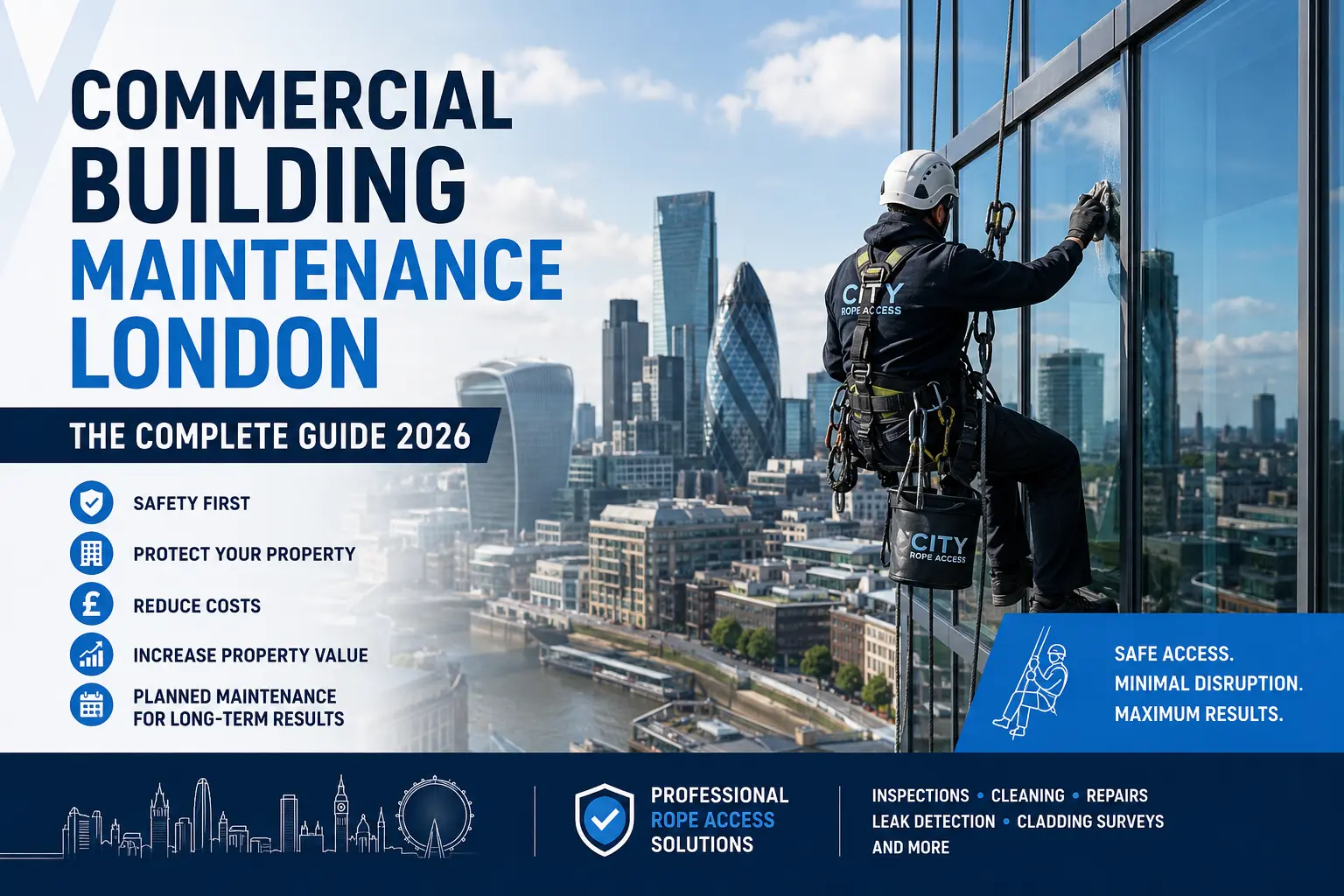
Commercial building maintenance in London involves much more than responding to visible defects. Property managers and facilities teams need to monitor façades, roofs, drainage, glazing, sealants and other external building elements before minor issues develop into costly and disruptive repairs.
London properties are exposed to changing weather conditions, pollution, heavy rainfall and constant use. At the same time, many commercial buildings have façades and roof areas that are difficult to inspect properly from ground level.
This guide explains some of the most common maintenance issues affecting commercial properties, how planned preventative maintenance can help and where specialist access methods can be useful for inspection and repair work.
If your property already requires high-level repair or maintenance work, see our rope access building maintenance and repair services in London .
What Is Commercial Building Maintenance?
Commercial building maintenance is the ongoing process of inspecting, cleaning, repairing and protecting a property so that its external and internal building elements remain functional and in suitable condition.
For property managers, the objective is not simply to fix defects after they become obvious. Effective maintenance should help identify deterioration early, prioritise repairs and reduce the risk of small problems developing into larger failures.
External maintenance can include work on:
- Building façades
- Brickwork, masonry and concrete
- Cladding systems
- Windows and external glazing
- Sealant and movement joints
- Roofs and roof-level elements
- Gutters and rainwater systems
- Parapets and architectural features
- External coatings and painted surfaces
- Difficult-to-access building areas
Why Regular Building Maintenance Matters
Many external building defects develop gradually. A failed sealant joint, cracked area of masonry or partially blocked drainage system may appear minor at first, but continued exposure to rain and temperature changes can allow the problem to spread.
Regular inspections and planned maintenance can help property managers:
- Identify defects before they become more serious
- Reduce the likelihood of unexpected emergency repairs
- Plan maintenance budgets more effectively
- Monitor areas with known historic problems
- Maintain the appearance of commercial properties
- Reduce disruption to tenants and building users
- Create a documented record of building condition over time
The appropriate maintenance strategy will depend on the age, design, condition and use of the property. A modern glazed office building may require a very different programme from an older masonry property.
Common Commercial Building Maintenance Problems in London
Although every property is different, there are several external defects that property and facilities managers commonly need to monitor.
Façade Cracks and Surface Defects
Cracks can develop in render, masonry, concrete and other façade materials for a variety of reasons. Some may be superficial while others can indicate movement, deterioration or localised material failure.
Close-up inspection is often necessary to establish the extent of a defect and determine whether remedial work is required.
Concrete Deterioration and Spalling
Concrete can deteriorate over time, particularly where moisture reaches embedded reinforcement. Corrosion can create pressure within the concrete and cause sections of the surface to crack or break away.
Loose or deteriorating material on a high-level façade should be investigated because falling debris can create a risk around the building.
For specialist remedial work, see our rope access concrete repair service .
Failed Sealant and Movement Joints
Sealant around windows, cladding panels and façade joints is designed to accommodate movement while helping protect the building envelope from water penetration.
As sealant ages it can crack, shrink, detach or lose flexibility. These defects may eventually allow moisture to enter the building.
Our dedicated mastic and sealant service covers difficult-to-access external joints and high-level areas.
Water Ingress and Damp
Water appearing inside a commercial property does not always originate directly above the visible damp area. Rainwater can enter through defective joints, roof details, parapets, cracks or façade penetrations and travel within the building construction before becoming visible internally.
This is why simply sealing the area where water appears is not always an effective repair. The external entry point first needs to be identified.
Where the source is unclear, see our leak detection and waterproofing service in London .
Cladding Defects
Commercial façades frequently incorporate cladding panels, flashings, trims, sealants and fixing systems. Individual components can deteriorate, become damaged or require closer inspection during the life of the building.
Ground-level observation cannot always provide sufficient detail, particularly on tall properties. Close access allows specific areas to be photographed and assessed more accurately.
For more information, read our guide to cladding inspections in London .
Blocked Gutters and Rainwater Systems
Gutters, outlets and rainwater systems play an important role in directing water away from the building. Leaves, debris and accumulated dirt can restrict drainage and contribute to overflowing water during periods of heavy rainfall.
High-level drainage components should therefore be included within an appropriate maintenance programme where relevant to the building.
Dirty or Difficult-to-Reach Glazing
Commercial properties with extensive external glazing may require specialist access to maintain windows that cannot be reached safely using conventional cleaning methods.
Regular cleaning also gives technicians an opportunity to visually observe nearby frames, seals and façade areas while working close to the exterior of the building.
See our rope access window cleaning service for high-rise and difficult-to-access glazing.
Planned Preventative Maintenance for Commercial Properties
Planned preventative maintenance, often referred to as PPM, is intended to identify and manage building defects before they result in more significant repair requirements.
Rather than waiting for water ingress, falling material or another visible failure, property managers can establish a programme that monitors key elements of the external building envelope.
A commercial building maintenance programme may include:
- Visual façade inspections
- Roof and roofline checks
- Gutter and drainage inspections
- Sealant and movement joint checks
- External window cleaning
- Cladding inspections
- Localised high-level repairs
- Painting and protective coating work
- Photographic condition reporting
There is no single maintenance frequency that is appropriate for every commercial property. The programme should reflect the age, construction, current condition, location and exposure of the building together with any relevant professional, manufacturer or insurer recommendations.
For a practical overview of areas worth monitoring, see our commercial building maintenance checklist .
How Should Property Managers Prioritise Repairs?
Not every defect requires the same level of urgency. A practical maintenance strategy should prioritise issues according to their condition, location and potential consequences.
Factors to consider may include:
- Whether material is loose or at risk of falling
- Whether water is entering the building
- Whether the defect is actively worsening
- Whether the area is located above a public space or entrance
- Whether failure could affect other building components
- Whether temporary measures are required before permanent repair
Photographic documentation can be especially useful when monitoring defects over time. Comparing images from previous inspections can help establish whether cracking, staining, sealant failure or other deterioration is progressing.
When Rope Access Can Be Useful for Commercial Building Maintenance
Rope access can be particularly useful when inspection or maintenance is required on difficult-to-reach areas of an occupied commercial building.
Unlike extensive scaffolding installations, rope access generally requires a relatively small ground-level footprint and can allow technicians to reach specific sections of a façade without surrounding the entire building with temporary access structures.
This can be useful for:
- Close-up façade inspections
- Localised masonry and concrete repairs
- Sealant replacement
- Leak investigations
- Window cleaning
- Painting and coating repairs
- Cladding inspections
- Photographic surveys
However, rope access is not automatically the correct solution for every project. Large-scale or long-duration works may be more suitable for scaffolding or another access system.
The most appropriate method should be selected according to the building, scope of work, site restrictions and expected project duration.
Rope Access vs Scaffolding for Maintenance Work
Both rope access and scaffolding have valid applications in commercial building maintenance. The choice should be based on the requirements of the project rather than assuming that one method is always better than the other.
| Factor | Rope Access | Scaffolding |
|---|---|---|
| Setup | Typically requires less temporary infrastructure | Requires installation around the work area |
| Ground-level footprint | Relatively small | Can occupy a larger area |
| Localised repairs | Often well suited | May involve more setup than required |
| Large or long-duration projects | Suitability depends on scope | Can provide continuous working access |
| Occupied properties | Can reduce disruption around the building | May have a greater impact on entrances and external areas |
For a more detailed comparison, read our guide to rope access vs scaffolding in London .
Why Close-Up Façade Inspection Matters
Some building defects are difficult to assess accurately from street level. Small cracks, failed seals, loose surface materials or deterioration around façade joints may only become clear when viewed at close range.
Close-up access can help document:
- Cracking and movement
- Loose or damaged masonry
- Concrete deterioration
- Failed sealants
- Corrosion staining
- Cladding defects
- Water staining
- Damaged flashings or external details
Photographs can then be used to support maintenance planning and help determine whether specialist repair or further investigation is required.
Maintenance for Occupied Commercial Buildings
One of the main challenges of commercial property maintenance is carrying out work while the building remains operational.
Offices, hotels, retail properties and mixed-use developments may have employees, customers, residents and contractors entering and leaving throughout the day. Access arrangements therefore need to consider how work can be completed while limiting unnecessary disruption.
Depending on the site, this may involve:
- Planning work around busy entrances
- Establishing appropriate exclusion areas
- Coordinating with facilities teams or building management
- Scheduling work around operational requirements
- Using access methods with a smaller footprint where appropriate
What Information Is Useful Before Requesting a Maintenance Quote?
The more information available at the beginning of a project, the easier it is to understand the likely scope and access requirements.
When contacting a contractor, it can be useful to provide:
- Property address
- Approximate building height or number of floors
- Photographs of the affected area
- A description of the observed defect
- Details of any previous repairs
- Information about roof or existing access systems
- Any known site restrictions
- Whether the issue is causing active water ingress or another urgent problem
Where the cause or full extent of a defect is unclear, an inspection may be required before an accurate repair scope can be established.
Commercial Building Maintenance Checklist
Property managers can use the following questions as a simple starting point when reviewing the external condition of a commercial building:
- Are there visible cracks or damaged areas on the façade?
- Is any concrete, render, stone or masonry loose?
- Are sealant joints cracked, detached or missing?
- Are there signs of water staining or internal damp?
- Are gutters and rainwater outlets flowing correctly?
- Are cladding panels or external components visibly damaged?
- Are painted or coated surfaces peeling or deteriorating?
- Are difficult-to-access areas being inspected periodically?
- Are photographs and maintenance records being retained?
- Are previously identified defects being monitored?
Frequently Asked Questions
How often should a commercial building be inspected?
There is no single inspection interval that is appropriate for every commercial property. The frequency should reflect the building’s age, construction, condition, exposure, previous defects and maintenance strategy, together with any relevant professional, manufacturer or insurer recommendations.
What is planned preventative maintenance?
Planned preventative maintenance is a structured approach to inspecting and maintaining a property before significant defects occur. The aim is to identify deterioration early, plan repairs and reduce the likelihood of unexpected failures.
Can rope access be used on occupied commercial properties?
Rope access can be suitable for many occupied properties because it normally requires less temporary access infrastructure than extensive scaffolding. The actual work still needs to be planned around the building, public areas and site-specific risks.
Can multiple maintenance tasks be completed during the same rope access visit?
Potentially, yes. Where appropriately planned, technicians may be able to carry out inspection and maintenance tasks during the same project. The scope should be agreed in advance so that the required equipment, materials and procedures are available.
How can water ingress in a commercial building be investigated?
The investigation should consider potential external entry points such as failed sealants, cracks, roof details, parapets, drainage systems and façade penetrations. Close-up inspection may be necessary when the suspected area is difficult to access.
Need Help With a Commercial Building Maintenance Issue?
City Rope Access supports property managers, facilities teams, landlords and contractors with high-level inspections, repairs and building maintenance across London.
If you have identified a defect, water ingress or another difficult-to-access maintenance issue, send us information about the property and the required work so our team can review the access requirements.