

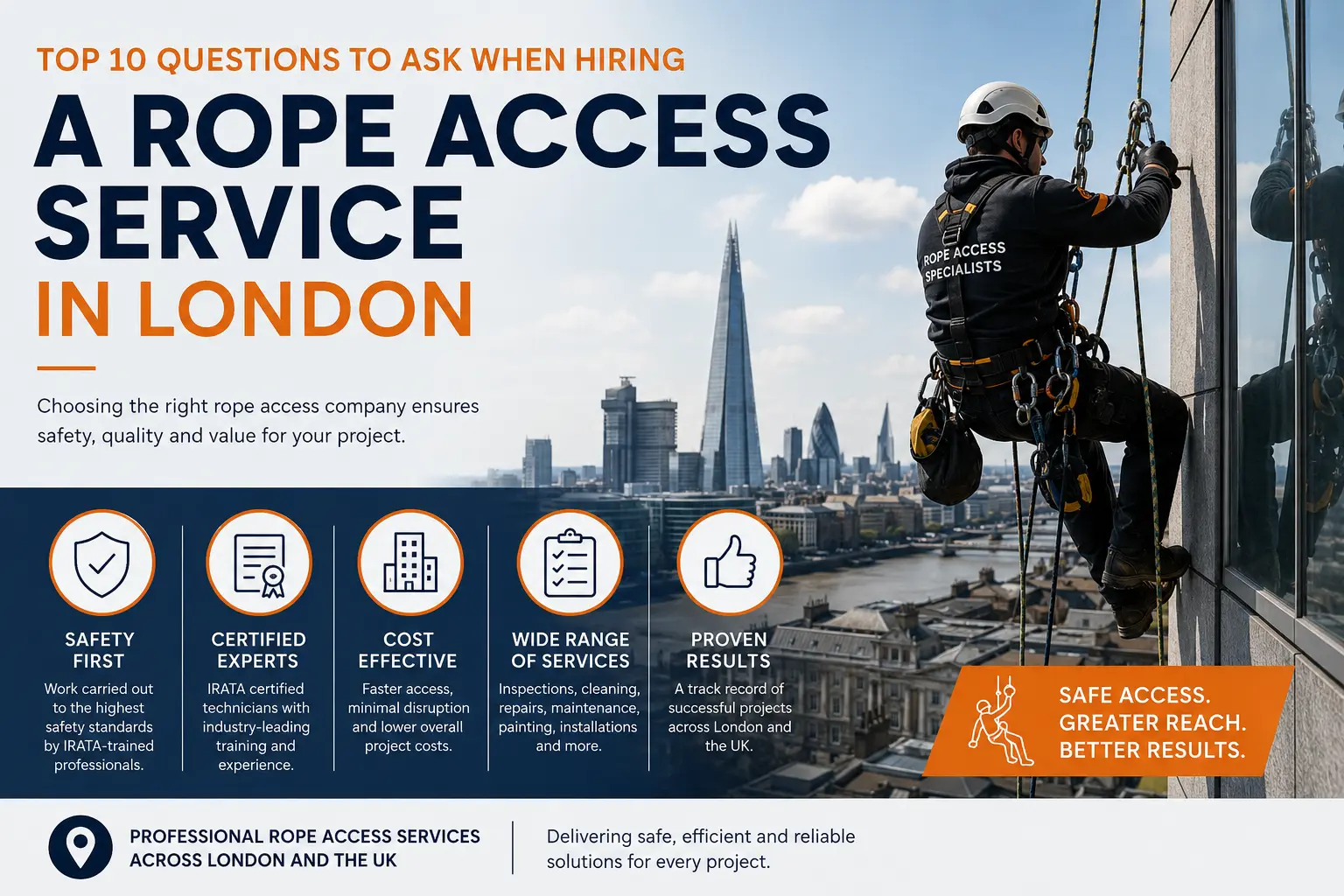
Understanding Rope Access Services
Rope access is a specialist method of working at height that allows technicians to safely reach difficult-to-access areas using ropes, harnesses, and advanced safety equipment. Originally developed for challenging industrial environments, rope access is now widely used across London for building maintenance, inspections, repairs, cleaning, façade restoration, and structural surveys.
Unlike traditional access methods such as scaffolding, cherry pickers, or cradles, rope access enables technicians to access specific work areas quickly and efficiently with minimal disruption to the surrounding environment. This makes it particularly suitable for busy London streets, commercial buildings, residential towers, historic properties, and complex architectural structures.
One of the main advantages of rope access services is their cost-effectiveness. Because there is no need for extensive scaffolding or heavy access equipment, projects can often be completed faster and with lower overall costs. The reduced setup time also means less inconvenience for building occupants, businesses, and pedestrians.
Professional rope access companies typically provide a wide range of services, including:
- Building and façade inspections
- External building maintenance and repairs
- High-rise window cleaning
- Roof inspections and maintenance
- Concrete and brickwork repairs
- Leak detection and waterproofing
- Painting and coating applications
- Installation of signage, lighting, and safety systems
- Structural surveys and condition assessments
Safety is a critical aspect of any rope access operation. Reputable contractors employ technicians trained to internationally recognised standards such as IRATA (Industrial Rope Access Trade Association). These strict training and certification requirements help ensure that work is carried out safely, efficiently, and in compliance with industry best practices.
When hiring a rope access company in London, understanding how these services work will help you evaluate providers more effectively and ensure you choose a contractor with the right experience, qualifications, and safety credentials for your project.
Safety Standards and Certifications
When hiring a rope access contractor in London, safety should be your highest priority. Working at height involves inherent risks, which is why professional rope access companies must follow strict industry regulations, safety procedures, and certification requirements to protect both technicians and the public.
One of the most important certifications to look for is IRATA (Industrial Rope Access Trade Association) accreditation. IRATA is recognised worldwide as the leading authority in rope access training and safety standards. Technicians progress through different certification levels, demonstrating increasing expertise, practical skills, and supervisory capabilities. Hiring an IRATA-trained team ensures that work is carried out according to internationally accepted safety practices.
A reputable rope access company should also maintain comprehensive risk assessments and method statements (RAMS) for every project. These documents identify potential hazards, outline control measures, and establish emergency rescue procedures before work begins. Proper planning significantly reduces risks and helps ensure compliance with UK health and safety legislation.
In addition to technician qualifications, contractors should carry appropriate insurance coverage, including public liability insurance and employer’s liability insurance. This provides protection for clients, employees, and third parties in the unlikely event of an incident occurring during the project.
Professional rope access teams also conduct regular equipment inspections and maintain detailed records of ropes, harnesses, helmets, anchors, and other safety equipment. All equipment should comply with relevant UK and European safety standards and be inspected before every use.
When evaluating a rope access provider, consider asking the following questions:
- Are your technicians IRATA-certified?
- What level of IRATA qualifications do your team members hold?
- Do you provide project-specific risk assessments and method statements?
- What insurance coverage does your company maintain?
- How often is your equipment inspected and replaced?
- What emergency rescue procedures are in place?
Choosing a contractor that prioritises safety standards and professional certifications not only reduces project risks but also ensures that work is completed efficiently, legally, and to the highest industry standards. For any rope access project in London, verified qualifications and a strong safety culture should be non-negotiable.
Project Experience and References
Experience plays a crucial role when selecting a rope access company in London. While certifications and safety procedures are essential, a contractor’s track record often provides the clearest indication of their ability to deliver high-quality results. Companies with extensive project experience are typically better equipped to handle complex access challenges, unexpected site conditions, and demanding deadlines.
Before hiring a rope access provider, ask about the types of projects they have completed in the past. Some companies specialise in commercial high-rise buildings, while others focus on residential developments, industrial facilities, bridges, heritage structures, or construction support services. Choosing a contractor with experience relevant to your specific project can significantly improve efficiency and reduce potential risks.
A reputable rope access company should be able to provide examples of previous work, including:
- Building façade inspections
- High-rise window cleaning
- Concrete and structural repairs
- External painting and coating projects
- Roof inspections and maintenance
- Cladding and façade installations
- Leak detection and waterproofing
- Historic building restoration
- Commercial and residential maintenance contracts
References from previous clients are equally important. Testimonials and case studies can provide valuable insight into the contractor’s professionalism, reliability, communication, and quality of workmanship. If possible, request references from projects that are similar in size and scope to your own requirements.
You should also ask whether the company has worked on buildings with comparable challenges, such as restricted access, busy public areas, listed properties, or occupied commercial premises. Experience in these environments often demonstrates a higher level of planning and problem-solving capability.
Some useful questions to ask include:
- How many years have you been providing rope access services?
- Have you completed projects similar to ours?
- Can you provide case studies or examples of previous work?
- Do you have client references available?
- Have you worked on similar buildings or structures in London?
- What were the biggest challenges on comparable projects and how were they resolved?
By reviewing a contractor’s project history and speaking with previous clients, you can gain greater confidence in their ability to deliver safe, efficient, and professional rope access services. A proven track record is often one of the strongest indicators of a reliable rope access partner.
Cost-Effectiveness and Pricing Transparency
Cost is often a major factor when choosing a rope access contractor, but the cheapest quote is not always the best value. When comparing rope access services in London, it is important to consider not only the price but also the scope of work, safety standards, experience, and overall quality of service.
One of the key advantages of rope access is its cost-effectiveness compared to traditional access methods. Because rope access systems require minimal equipment and setup time, projects can often be completed more quickly and with lower labour costs than scaffolding, mobile elevated work platforms (MEWPs), or other access solutions. This can result in significant savings, particularly for inspections, maintenance, and repair work on high-rise buildings.
However, pricing structures can vary between contractors. A professional rope access company should provide a clear and detailed quotation that outlines exactly what is included in the service. This helps prevent unexpected costs and allows clients to make accurate comparisons between providers.
When reviewing quotations, look for details such as:
- Scope of work and project objectives
- Number of technicians required
- Estimated project duration
- Equipment and access costs
- Safety planning and supervision
- Materials and repair costs (if applicable)
- Waste removal and site clean-up
- Any potential additional charges
Transparency is a strong indicator of a trustworthy contractor. If a quotation appears significantly lower than competitors, it is worth investigating whether essential elements such as safety supervision, insurance, specialist equipment, or project management have been excluded.
Some useful questions to ask include:
- Is the quotation fixed-price or subject to change?
- What services are included in the quoted cost?
- Are there any potential additional charges?
- How do you handle unforeseen issues discovered during the project?
- Does the price include all equipment, labour, and safety requirements?
- Can you provide a detailed written breakdown of costs?
A reputable rope access company will be open about its pricing and willing to explain how costs are calculated. Clear communication and transparent quotations help clients budget effectively, avoid surprises, and ensure they receive the best value for their investment.
Ultimately, the most cost-effective rope access service is one that combines competitive pricing with proven expertise, strong safety standards, and reliable project delivery. Choosing value over simply selecting the lowest quote can lead to better results and lower long-term maintenance costs.