

Imagine discovering that your commercial building needs repairs to the façade on the tenth floor.
The work itself might only take a single day.
However, before anyone can even begin, scaffolding has to be designed, delivered, erected, inspected and eventually dismantled. The building entrance may need to be partially closed, tenants notified and parking spaces restricted. What could have been a straightforward repair quickly becomes a project lasting several weeks.
Now imagine the same repair carried out using professional rope access.
Within a matter of hours, experienced IRATA-certified technicians are safely suspended from the roof, inspecting the affected area and completing repairs with minimal disruption to the people inside the building.
This is one of the main reasons rope access has become the preferred maintenance solution for commercial properties throughout the UK.
Why Access Costs Often Exceed Repair Costs
Many property owners assume that repairing a building is the expensive part of the project.
In reality, access equipment frequently represents a significant proportion of the total cost.
Traditional scaffolding involves:
- transport
- installation
- inspections
- permits
- dismantling
- restricted access around the building
For relatively small repair projects, these costs can sometimes exceed the cost of the repair itself.
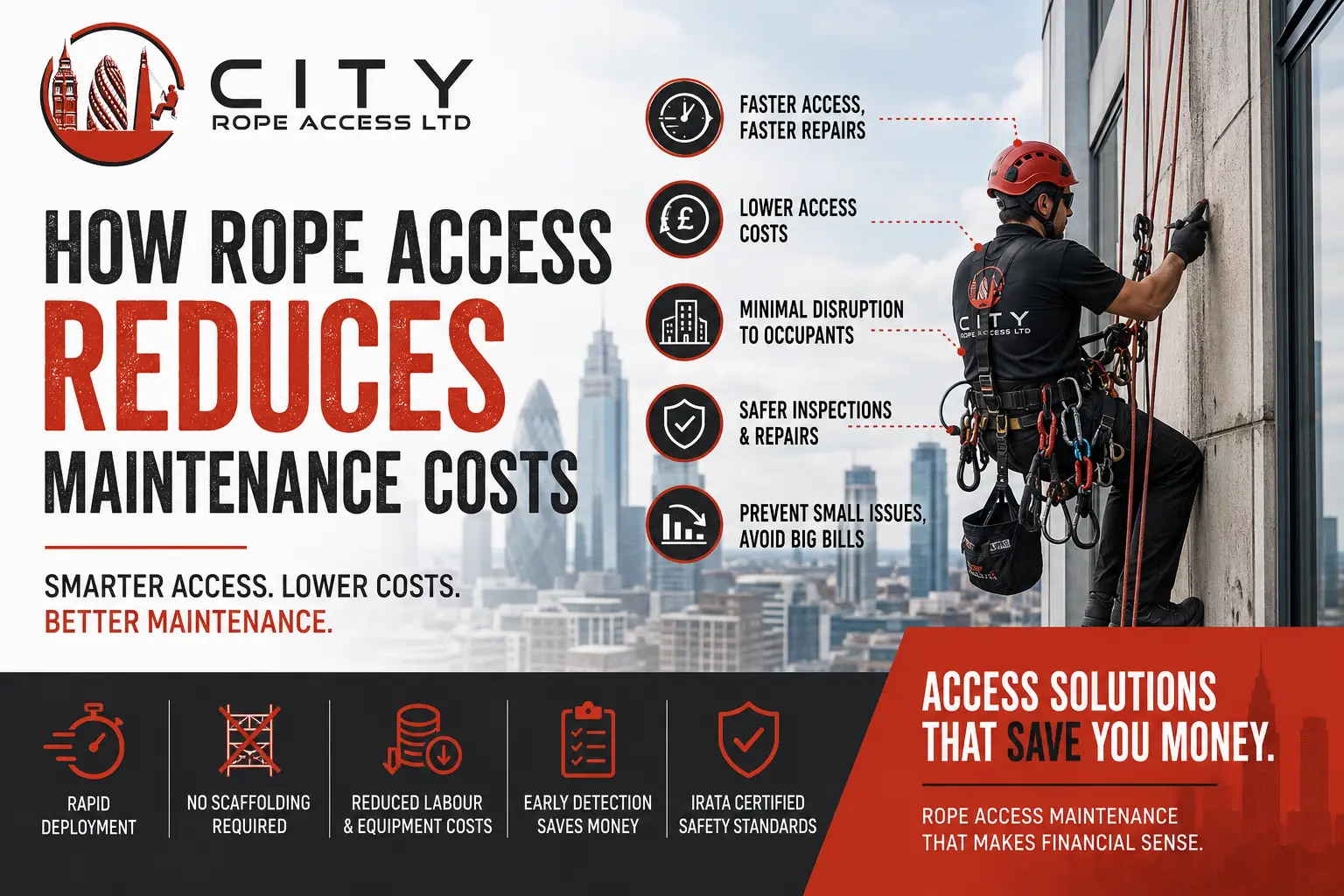
Rope access removes much of this unnecessary expense by allowing technicians to reach difficult locations quickly and safely.
Faster Access Means Faster Repairs
One of the greatest advantages of rope access is speed.
Instead of waiting days or weeks for scaffolding to be installed, technicians can often begin work shortly after arriving on site.
This allows building owners to address problems before they become more serious.
Typical rope access projects include:
- façade inspections
- concrete repairs
- sealant replacement
- window inspections
- cladding inspections
- waterproofing
- leak investigations
- building maintenance
Our professional Rope Access Services
allow maintenance work to begin with minimal delay.
Less Disruption for Occupants
Commercial buildings rarely stand empty.
Office workers, retail customers, hotel guests and residents all expect businesses to continue operating as normal.
Large scaffolding structures can:
- block entrances
- reduce natural light
- restrict parking
- create noise
- interfere with daily operations
Rope access technicians work directly on the area requiring attention, reducing disruption for everyone using the building.
Lower Equipment Costs
Scaffolding remains an excellent solution for large-scale refurbishment projects.
However, many maintenance tasks simply don’t require such extensive access systems.
For inspections and localised repairs, rope access often provides a much more economical solution.
The reduced equipment requirements help lower overall project costs while maintaining high safety standards.
Early Repairs Prevent Larger Bills
One of the biggest financial advantages of rope access is that it encourages preventative maintenance.
Because access is faster and more affordable, property managers are more likely to investigate small defects before they become major structural issues.
Examples include:
- replacing failed sealants
- repairing cracked render
- fixing loose brickwork
- treating corrosion
- repairing damaged waterproofing
Small repairs completed early almost always cost less than emergency structural works.
If you’re developing a planned maintenance programme, don’t miss our Preventative Building Maintenance Guide.
Ideal for High-Rise Buildings
Modern commercial buildings often present difficult access challenges.
Using rope access, technicians can safely inspect:
- façades
- balconies
- roof edges
- curtain walling
- cladding systems
- glazing
- steelwork
Without requiring large access structures, maintenance can often be completed more efficiently.
Rope Access Supports Preventative Maintenance
Many building owners only arrange inspections after a problem has already appeared.
Unfortunately, by that stage the defect has often existed for months.
Regular maintenance inspections help identify:
- water ingress
- façade defects
- loose masonry
- damaged cladding
- concrete deterioration
- failed sealants
Our Building Façade Inspection Checklist
explains the warning signs every property manager should recognise before minor defects become expensive repairs.
Accurate Inspections Save Money
Technicians working directly on the building can inspect defects far more closely than someone viewing the façade from ground level.
This allows maintenance teams to:
- identify hidden defects
- prioritise repairs
- avoid unnecessary work
- prepare accurate repair quotations
- document building conditions with photographs
Better information leads to better maintenance decisions.
If deterioration has already begun, our article How to Spot Façade Defects Before They Become Dangerous
shows exactly what to look for.
Rope Access Improves Safety
Safety is naturally one of the biggest priorities during any maintenance project.
Professional rope access technicians are trained to internationally recognised IRATA standards.
Their work involves:
- multiple backup systems
- continuous safety procedures
- specialised equipment
- regular inspections of all gear
- detailed rescue planning
For many maintenance projects, rope access provides an extremely safe and efficient working method.
Common Maintenance Tasks Completed Using Rope Access
Rope access is suitable for a wide variety of commercial building maintenance projects, including:
- façade inspections
- concrete repairs
- cladding inspections
- waterproofing
- brickwork repairs
- glazing inspections
- leak detection
- sealant replacement
- bird proofing
- roof edge inspections
Because technicians can move freely across the building, several maintenance tasks can often be completed during the same visit.
If you’re concerned about deteriorating concrete, read Concrete Spalling Explained
to understand why early intervention is so important.
When Is Rope Access the Best Choice?
Rope access is particularly effective when:
- only part of the building requires repairs
- scaffolding would be expensive
- disruption needs to be minimised
- access is difficult
- inspections need to be completed quickly
- work is required at height
For extensive refurbishment projects, scaffolding may still be appropriate, but for inspections and localised maintenance, rope access is often the more efficient solution.
Commercial roof inspections are another excellent example.
Learn more in our Commercial Roof Inspection Guide
Investing in Early Maintenance Always Costs Less
Building maintenance should never be viewed as an unnecessary expense.
It’s an investment that protects the value of the property while reducing the likelihood of unexpected repair bills.
By making inspections easier, reducing access costs and allowing maintenance to be carried out more quickly, rope access helps property owners deal with problems before they escalate into major structural issues.
Whether you’re responsible for an office building, apartment block, industrial facility or commercial development, choosing the right access method can significantly reduce both maintenance costs and disruption.
If you’re looking for a safe, efficient and cost-effective way to inspect or maintain your building, City Rope Access provides professional rope access solutions for commercial properties throughout London.
Frequently Asked Questions
Is rope access cheaper than scaffolding?
For inspections, surveys and localised repairs, rope access is often significantly more cost-effective because it eliminates the need for extensive scaffolding while reducing setup time.
What maintenance work can be carried out using rope access?
Rope access is commonly used for façade inspections, concrete repairs, waterproofing, cladding inspections, sealant replacement, leak detection, roof inspections and general building maintenance.
Is rope access safe?
Yes. Professional rope access technicians follow strict IRATA safety standards and use specialist equipment with multiple backup systems.
Does rope access reduce disruption?
Absolutely. Because technicians access only the areas that require work, businesses, residents and visitors experience far less disruption than with traditional scaffolding.